
What is 3Commas?
3Commas is a cloud-based cryptocurrency trading automation platform that has been serving traders since 2017. Founded by Yuriy Sorokin and based in Estonia, the platform has grown to support over 1 million users across 150+ countries. Unlike simple trading bots, 3Commas positions itself as a comprehensive trading ecosystem that combines automated strategies, portfolio management, and copy trading features.
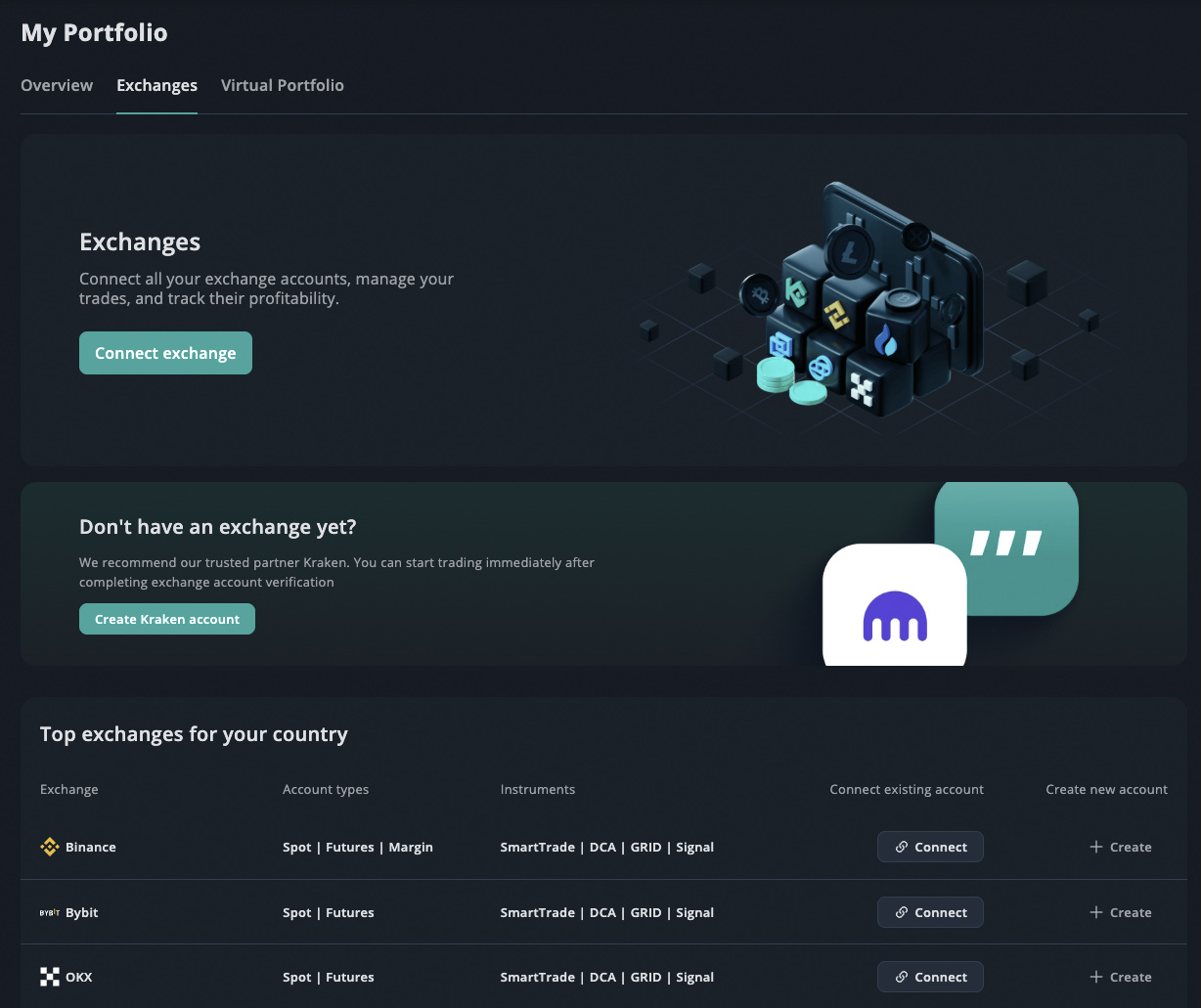
The platform connects with major cryptocurrency exchanges including Binance, Coinbase Pro, KuCoin, and over 25 others, allowing users to execute automated trades without transferring funds to a third party. This non-custodial approach means your cryptocurrency remains in your exchange account while 3Commas manages the trading through API connections.
Key Features and Capabilities
DCA (Dollar Cost Averaging) Bots
3Commas' flagship feature is its DCA bot system, which automatically purchases additional units of a cryptocurrency as its price decreases. Here's how it works:
- Safety Orders: The bot places additional buy orders at predetermined price levels below the initial purchase
- Take Profit Targets: Once the average price recovers and reaches your profit target, the bot sells the entire position
- Customizable Parameters: Users can set the number of safety orders, price deviation percentages, and profit targets
For example, if you set up a DCA bot for Bitcoin with a $1,000 initial investment and 5 safety orders of $500 each, the bot will buy additional Bitcoin every time the price drops by your specified percentage (say 2.5%). This averages down your entry price and can be profitable when the market recovers.
Grid Trading Bots
Grid bots work by placing multiple buy and sell orders within a defined price range, profiting from market volatility. The bot creates a "grid" of orders that automatically execute as prices move up and down within the range. This strategy works particularly well in sideways or ranging markets.
HODL Bot
The HODL bot is designed for long-term investors who want to accumulate cryptocurrency over time. It makes regular purchases regardless of price movements, implementing a pure dollar-cost averaging strategy without the complexity of safety orders or take profit targets.
Options Bot
This advanced feature allows experienced traders to sell covered calls on their cryptocurrency holdings, generating additional income from their positions. The bot automatically manages the options positions and can help generate yield in flat markets.
Copy Trading
3Commas offers a copy trading feature where users can automatically replicate the trades of successful traders. The platform provides detailed statistics on each trader's performance, including profit/loss history, maximum drawdown, and risk metrics.
Supported Exchanges and Assets
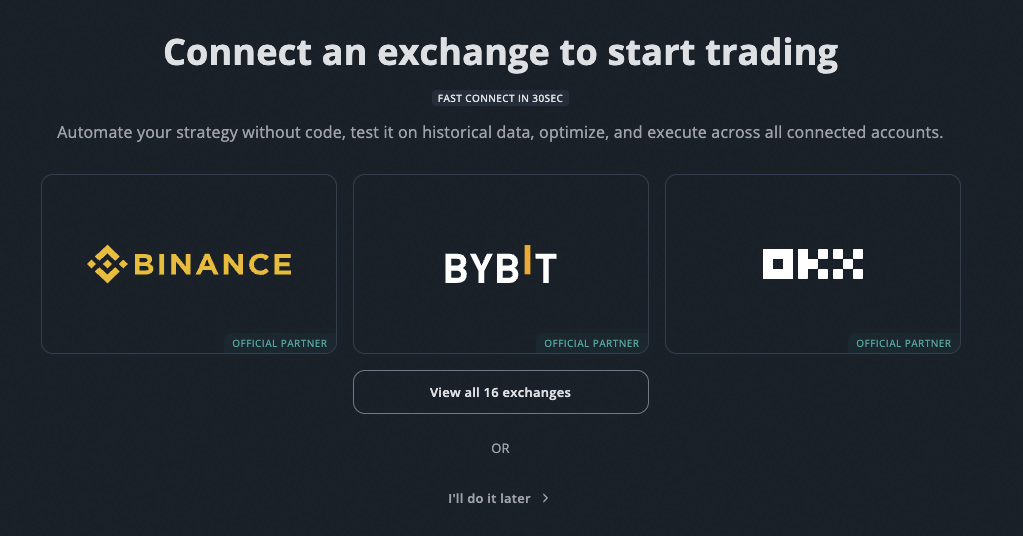
3Commas integrates with over 25 cryptocurrency exchanges, including:
The platform supports hundreds of cryptocurrency pairs, though the specific pairs available depend on your connected exchange. Most major cryptocurrencies like Bitcoin, Ethereum, and top altcoins are supported across all integrated exchanges.
Pricing Structure
3Commas operates on a subscription-based pricing model with three tiers:
Starter Plan - €20/month
- 5 active DCA bots
- 1 active grid bot
- Basic portfolio management
- Email support
- Mobile app access
Advanced Plan - €50/month
- Unlimited DCA bots
- 5 active grid bots
- Copy trading access
- TradingView indicators
- Priority support
- Advanced analytics
Pro Plan - €140/month
- All Advanced features
- Unlimited grid bots
- Options bot access
- Custom bot templates
- API access for developers
- White-label solutions
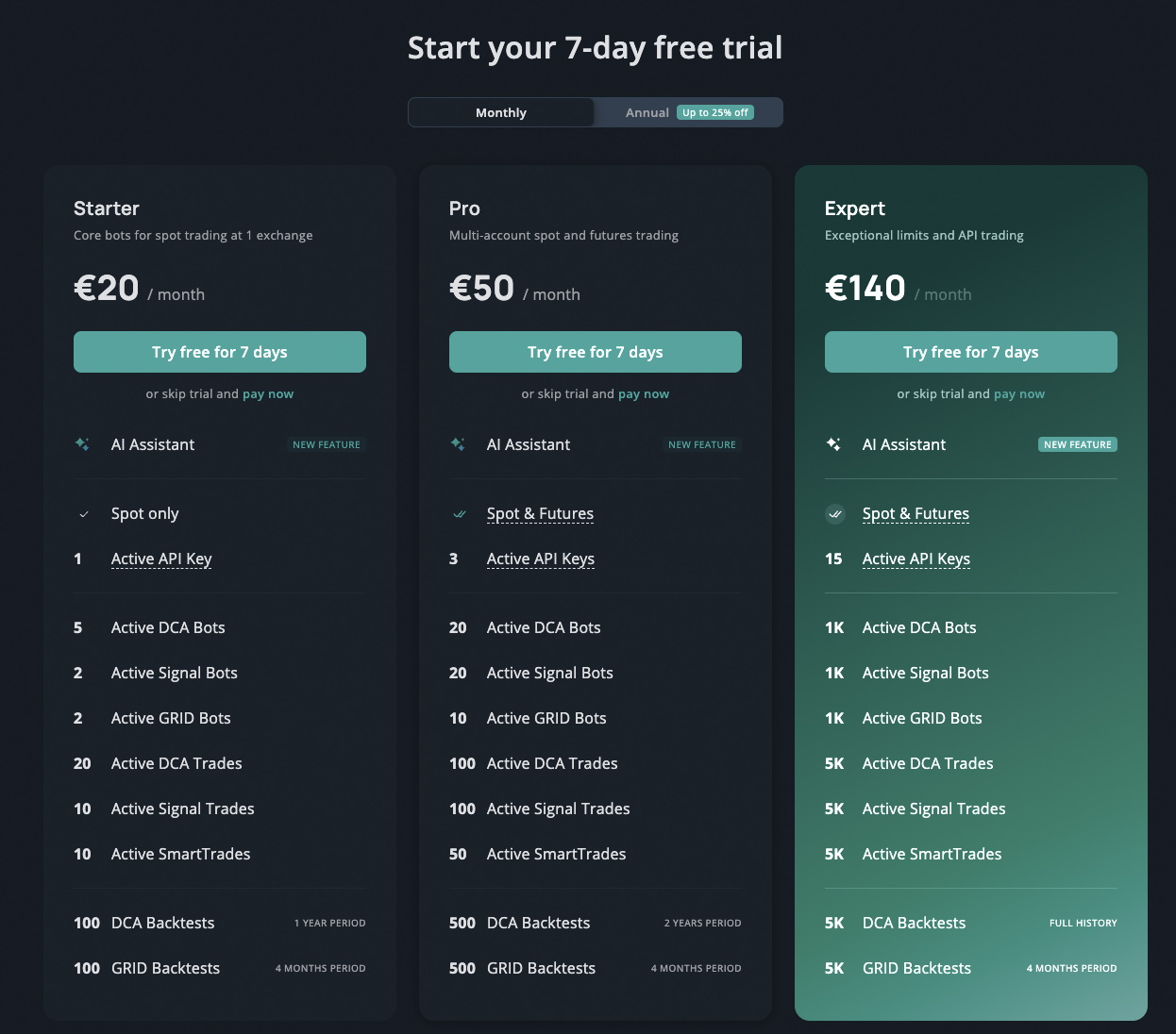
The platform also offers annual subscriptions with approximately 17% discount compared to monthly billing. There's a 3-day free trial available, though it requires credit card information upfront.
User Interface and Experience
3Commas provides both web-based and mobile applications. The interface is generally intuitive, though it can feel overwhelming for beginners due to the numerous features and configuration options.
Dashboard
The main dashboard provides an overview of your active bots, portfolio performance, and recent trades. Key metrics like total profit/loss, active deals, and bot performance are displayed prominently.
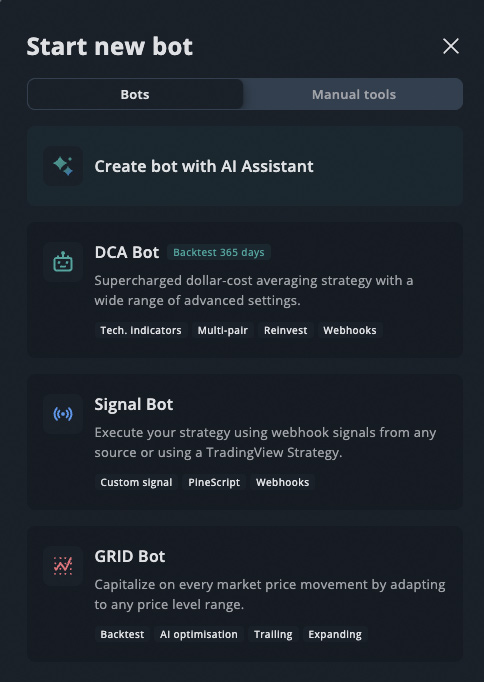 Bot Creation Process
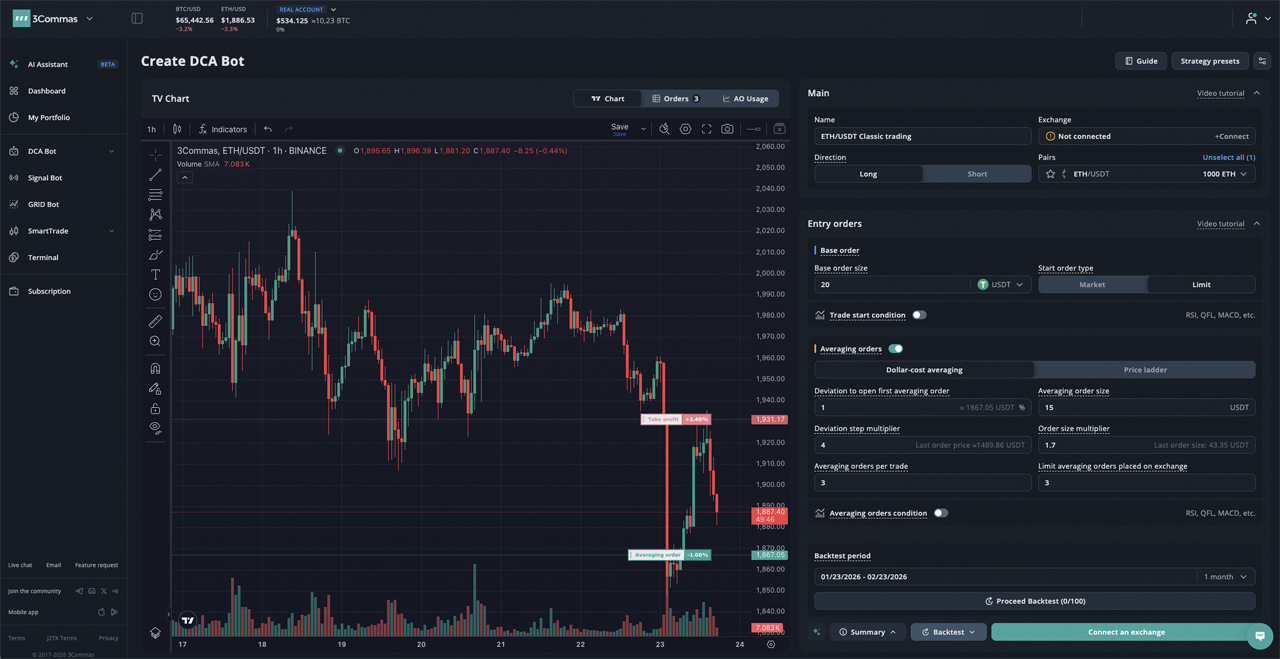
Setting up a bot involves several steps:
- Choose bot type (DCA, Grid, HODL)
- Select exchange and trading pair
- Configure parameters (investment amount, safety orders, profit targets)
- Set additional conditions (stop-loss, trailing take profit)
- Review and activate the bot
The platform provides templates and presets to help beginners, but the learning curve can be steep for those new to automated trading.
Performance and Reliability
Backtesting Capabilities
3Commas offers backtesting for DCA bots, allowing users to test their strategies against historical data. While useful, the backtesting feature has limitations:
- Limited to 3-month periods on lower-tier plans
- Doesn't account for exchange fees in some scenarios
- Market conditions can change, making past performance less predictive
Real-World Performance Data
Based on user reports and platform statistics, DCA bot performance varies significantly depending on market conditions and configuration:
- Bull Markets: Simple buy-and-hold often outperforms DCA bots
- Volatile/Sideways Markets: DCA bots tend to perform better by capitalizing on price swings
- Bear Markets: DCA bots can help average down positions but may still result in losses if the market continues declining
Grid bots have shown more consistent performance in ranging markets, with some users reporting 10-30% annual returns, though results vary significantly based on market conditions and configuration.
Security Features
3Commas implements several security measures to protect user accounts and trading activities:
- API-Only Access: The platform never requires withdrawal permissions from exchanges
- Two-Factor Authentication: Available for all account tiers
- IP Whitelisting: Users can restrict access to specific IP addresses
- Encryption: All data transmission uses SSL encryption
- Regular Security Audits: The platform undergoes periodic security assessments
However, users should note that API keys still grant trading permissions, and a compromised 3Commas account could potentially result in unauthorized trades.
Advantages of Using 3Commas
- Comprehensive Feature Set: Multiple bot types and trading strategies in one platform
- Exchange Diversity: Supports most major cryptocurrency exchanges
- Non-Custodial: Your funds remain on your exchange account
- Active Community: Large user base sharing strategies and tips
- Mobile Access: Full-featured mobile apps for iOS and Android
- Educational Resources: Extensive documentation and video tutorials
- Copy Trading: Learn from successful traders by copying their strategies
Potential Drawbacks
- Steep Learning Curve: Complex interface may overwhelm beginners
- Subscription Costs: Monthly fees can be significant, especially for smaller accounts
- No Guaranteed Profits: Bots can lose money in trending markets
- Limited Customer Support: Response times can be slow, especially for lower-tier plans
- Over-Optimization Risk: Too many features may lead to over-complicated strategies
- Market Dependency: Performance heavily depends on market conditions
Best Practices for Success
Start Small and Simple
Begin with small investments and basic DCA bot configurations. Avoid the temptation to use all available features immediately. Focus on understanding one bot type thoroughly before expanding to others.
Proper Risk Management
- Never invest more than you can afford to lose
- Use stop-loss orders to limit downside risk
- Diversify across multiple trading pairs and strategies
- Regularly review and adjust bot parameters based on market conditions
Market Analysis
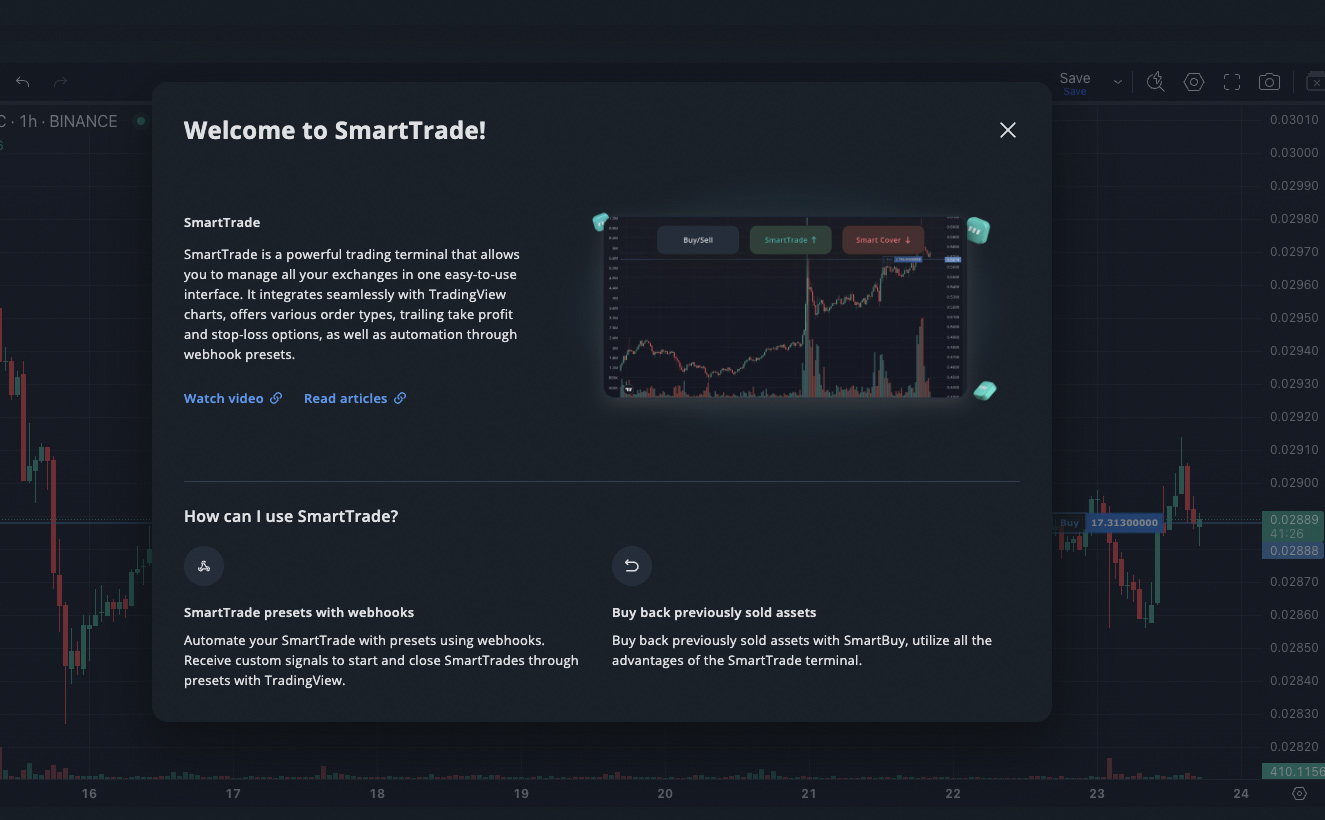
While bots automate execution, successful trading still requires market analysis. Use 3Commas' integration with TradingView to analyze trends and adjust your strategies accordingly.
Regular Monitoring
Automated doesn't mean "set and forget." Regularly monitor your bots' performance and be prepared to pause or adjust them during significant market changes.
Comparison with Competitors
3Commas competes with platforms like Pionex, Cryptohopper, and HaasOnline. Here's how it stacks up:
- vs. Pionex: 3Commas offers more customization but at a higher cost (Pionex is free with exchange fees)
- vs. Cryptohopper: Similar feature sets, but 3Commas has better exchange integration
- vs. HaasOnline: 3Commas is more user-friendly, while HaasOnline offers more advanced customization
Who Should Use 3Commas?
3Commas is best suited for:
- Intermediate to advanced cryptocurrency traders
- Users comfortable with subscription-based pricing
- Traders wanting to automate DCA or grid strategies
- Those interested in copy trading features
- Users with accounts on supported exchanges
It may not be ideal for:
- Complete beginners to cryptocurrency trading
- Users with very small trading accounts (fees may outweigh profits)
- Those preferring simple buy-and-hold strategies
- Traders wanting completely free solutions
Final Verdict
3Commas is a mature, feature-rich platform that can be valuable for traders looking to automate their cryptocurrency strategies. The platform's strength lies in its comprehensive approach, combining multiple bot types with portfolio management and copy trading features.
However, success with 3Commas requires dedication to learning the platform, proper risk management, and realistic expectations about automated trading. The subscription cost means it's most suitable for traders with larger accounts who can justify the monthly fees through improved trading efficiency or profits.
Before committing to a paid subscription, take advantage of the free trial to test the platform with your trading style and account size. Remember that no trading bot can guarantee profits, and automated trading still requires active management and market awareness to be successful.
Frequently Asked Questions About 3Commas
Is 3Commas a Scam?
No. 3Commas has been operating since 2017 and is widely regarded as a legitimate, utility-first trading bot platform. It serves hundreds of thousands of users worldwide and integrates with major exchanges like Binance, Coinbase, and Kraken through official API connections. The company is registered and transparent about its team and operations.
Is 3Commas Safe?
3Commas connects to your exchange via API keys and does not hold your funds or have access to withdraw them. The platform supports two-factor authentication (2FA), encrypted API key storage, and IP whitelisting. Always create API keys with trading permissions only — disable withdrawals to add an extra layer of protection. Following the 2022 API key incident, 3Commas significantly upgraded its security infrastructure.
How Do You Withdraw Money From 3Commas?
You do not deposit funds into 3Commas. All your balances and trading profits remain on your connected exchange (Binance, Kraken, Coinbase, etc.). To withdraw your profits, simply log into the exchange where your bots trade and withdraw directly from there. 3Commas only sends trade signals — it never holds your money.
Does 3Commas Offer a Free Plan?
Yes. 3Commas offers a free tier that includes basic DCA bot functionality and limited SmartTrade access. This lets you test the platform before committing to a paid plan. Paid plans unlock advanced features like grid bots, signal bots, and unlimited active deals.
What Exchanges Does 3Commas Support?
3Commas supports 20+ major cryptocurrency exchanges including Binance, Coinbase Advanced, Kraken, KuCoin, Bybit, OKX, Bitfinex, and Gate.io. The full list of supported exchanges is available on their integrations page, and new exchanges are added regularly.
Is 3Commas Good for Beginners?
Yes, 3Commas is considered one of the more beginner-friendly bot platforms. It offers pre-configured bot templates, a marketplace of trading strategies from experienced users, and a clean interface that guides new users through setup. The free plan makes it easy to start without financial risk.




Comments
166One metric the guide completely ignores is deal win rate versus actual realized PnL — I track both separately in a spreadsheet and the divergence is often alarming. A bot can show 80%+ win rate while still being net negative once you account for the capital tied up in open deals that never hit take profit. Position sizing relative to total portfolio exposure is the actual risk variable that matters here, and 3Commas gives you almost no native tooling to monitor that in aggregate.
Something this guide completely glosses over is the lack of any real accountability when a bot executes a deal at an obviously wrong price during low-liquidity periods. I had a DCA bot average down into a coin that was being delisted — 3Commas' support basically told me market conditions are 'outside their control' and closed my ticket. At what point does a platform charging these subscription fees take some responsibility for the tools they're selling?
Adding to my earlier comment — another thing nobody warns you about is that when an exchange has API rate limit issues, 3Commas doesn't always surface a clear error. Your bot just... sits there looking like it's working fine while missing entries. Took me three missed trades before I even realized something was wrong, and support basically told me to check the exchange status page myself.
A few things I wish the guide covered more thoroughly before I started: (1) the difference between USDT-margined and coin-margined bots and how that affects your actual exposure, (2) how the active deals limit interacts with your total portfolio allocation — it's easy to accidentally over-commit capital across multiple bots, (3) the importance of setting a max active deals per pair, not just globally. These aren't obvious from the UI and I only figured them out after running the numbers manually in a spreadsheet.
honestly the learning curve on this thing is no joke lol. spent like two weeks just figuring out take profit settings before touching anything real. guide makes it sound simpler than it is ngl.
Nobody talks about the mobile app being basically useless for making real-time adjustments during a fast-moving market. Tried to manually close a deal during a flash dump last month and the app kept timing out — ended up losing an extra 4% just waiting for it to respond. The desktop version is fine but if you're away from your computer you're kind of flying blind.
Ryan, the mobile app thing hit me so hard during my first month — I was at dinner and a coin I had a bot running on just started tanking and I literally could not close the deal fast enough through the app. That was an expensive lesson about always having a laptop nearby or at least pre-setting panic stop conditions before you walk away from your desk!
Okay so I just discovered you can set custom deal start conditions using TradingView signals and I feel like I unlocked a whole new level?? Nobody in the guide really emphasizes how much that changes things — my bot actually skipped a bad entry last night because of it and I was just sitting there refreshing the screen like 🎉 still so much to learn but this platform genuinely keeps surprising me!
Mike, your TradingView signal discovery just sent me down a two-hour rabbit hole and honestly THANK YOU because I had no idea that was even possible — I've been manually watching charts like an amateur this whole time. Just set up my first custom condition using RSI and it triggered a deal perfectly on the first try, I'm genuinely shaking lol.
One thing that really helped me get started without feeling overwhelmed: I actually mapped out a simple checklist before activating my first bot — (1) set your base order size to no more than 2% of total capital, (2) manually paper trade the same strategy for 72 hours first, (3) review your deal start conditions twice before going live. It sounds tedious but it saved me from a couple of rookie mistakes I would have definitely made otherwise. Happy to share the full checklist if anyone wants it!
One thing I haven't seen mentioned yet: the safety orders spacing configuration is super easy to miscalibrate if you're just eyeballing it. I actually put together a config screenshot walkthrough in a separate post showing how I set deviation percentages relative to the asset's 30-day ATR — happy to link it here if anyone wants a starting point, especially newer folks feeling overwhelmed by all the edge cases being discussed.
Olivia, the safety orders miscalibration problem is as old as DCA bots themselves — used to do the same thing manually on spreadsheets back before any of these platforms existed, and at least then you felt the pain immediately instead of discovering it three weeks later when your bot has averaged down into oblivion. The tool makes it faster, which unfortunately also means it makes the mistakes faster.
Something worth adding to this discussion from a backtesting perspective: the guide's performance benchmarks appear to be based on spot markets only, which systematically overstates returns for anyone running bots on futures pairs. In my backtests across 18 months of data, the funding rate drag on perpetual contracts reduced net bot performance by roughly 8-14% annually depending on market regime — that's a material difference that should be front and center in any honest guide.
Something the guide glosses over entirely: withdrawal limits during high volatility periods. Had a situation in March where my bots were sitting on solid unrealized gains and I literally could not pull funds fast enough because 3Commas was queuing withdrawal requests behind bot margin operations. Lost a meaningful chunk waiting. Not a catastrophic failure, not blaming them entirely, but it's a real operational risk that deserves at least a footnote.
Alex, the withdrawal limit thing is genuinely cursed — like you set up this whole automated system to make money and then the one time you actually want to *take* the money it's 'sorry, try again Tuesday.' Peak irony.
Okay I know this thread is heavy on warnings but I just have to share — my second week in and my DCA bot actually closed its first deal in profit this morning!! Small win, maybe $14, but after reading all these comments I was genuinely nervous I'd messed something up. Really grateful this community exists to help newbies like me actually understand what they're getting into.
Mike, so glad you shared that win — honestly threads like this can get a bit heavy with the warnings (all valid!) and it's easy to forget that bots genuinely do work when you set them up thoughtfully. My first profitable close took about three weeks and I remember the relief vividly. Keep tweaking your DCA settings as the market shifts and you'll keep seeing results like that!
Another thing nobody mentions: the bot prioritization queue. When you have multiple bots running simultaneously and the market moves fast, 3Commas doesn't execute them in any predictable order — I've had my higher-capital bots sitting idle while smaller ones churn through cycles first. Lost a solid entry on ETH last month because of exactly this. There needs to be a user-configurable priority system and there just isn't one.
Ryan, the bot queue thing is real. Had two bots basically fighting over the same pair during a pump and it was a mess. One pair per bot, lesson learned 👍
Oh wow I did NOT know about the slippage thing or the API rate limiting — adding both to my 'things to research before scaling up' list! Being a beginner is honestly just a continuous series of 'wait, that's also a thing I have to worry about?' moments lol.
One thing the guide doesn't address that I've tracked over 4 years of bot trading: slippage on the take-profit leg eats into returns far more than the subscription cost ever does. On high-volatility altcoin pairs I've seen realized gains come in 0.8-1.4% below the bot's reported TP — multiply that across hundreds of closes per month and you're looking at meaningful drag that never shows up in the platform's own analytics.
Guide says 'proven performance' but where are the audited trade logs? Screenshots from a dashboard anyone can manipulate aren't evidence — I want third-party verified P&L over a full market cycle including a proper bear leg, not just the cherry-picked bull runs these platforms love to showcase. Until 3Commas or an independent auditor publishes that, I'm treating every 'result' in here as marketing.
Patrick, your point about audited trade logs is well-taken — I actually cross-referenced 3Commas' stated performance methodology against their public API documentation (v2 spec, last updated Q1 2026) and the metrics shown in the dashboard aggregate realized PnL without accounting for funding fees on perpetual futures positions. That's a meaningful omission that can inflate reported returns by 3-8% depending on the asset and holding period.
Ok so I'm a complete newbie and I literally just set up my first DCA bot last week — made the rookie mistake of not setting a max active deals limit and it tied up almost my entire balance in one pair during a flash dip 😅 Learned REAL fast that the default settings in the guide are not "set it and forget it" the way they make it sound. Just wanted to share in case any other beginners are lurking here thinking this is plug-and-play!
For anyone feeling overwhelmed by the risk discussions in this thread — totally valid concerns, but don't let perfect be the enemy of functional. I started with a single DCA bot on a small allocation, documented every setting change in a spreadsheet, and that paper trail alone saved me from two bad configuration decisions I would have repeated otherwise. Happy to share the template if anyone wants a starting point.
Something this guide conveniently skips over: what happens to your open bot positions during a 3Commas outage? I've seen three separate incidents in the past 18 months where the platform went dark during high-volatility windows — exactly the moments when you most need intervention. Who's actually tracking the correlation between platform downtime events and adverse price movements? Because that number would be far more meaningful than any backtest figure they publish.
Tom, your point about outages and open positions is something I've actually quantified — across three separate backtests spanning late 2024 through mid-2025, simulated downtime windows of even 45–90 minutes during high-volatility sessions produced drawdown differentials of 8–14% compared to uninterrupted runs on the same pairs. The guide really should flag this as a material risk factor rather than burying it in the FAQ.
Ben, the API key situation you mentioned is even worse than you're letting on — I had a bot silently fail to execute a sell order because 3Commas had a permissions mismatch after a routine key refresh, and I only found out when I manually checked the exchange. No alert, no error log surfaced in the dashboard, nothing. That kind of silent failure in a live trading environment is genuinely unacceptable.
Ryan, the silent failure issue you raised extends to another edge case nobody talks about: what happens when the exchange rate-limits your API key mid-deal because another application is sharing it? Suddenly your safety orders stop filling, your DCA ladder is incomplete, and the bot reports everything as 'active' while your position is essentially unprotected. Worth stress-testing that scenario before going live with real size.
One dimension conspicuously absent from this guide and the discussion so far: counterparty concentration risk. When you're running multiple bots across the same exchange via a single platform like 3Commas, your operational exposure isn't just to market moves — it's to a cascading failure chain where a platform outage, an exchange API deprecation, and a volatile open position all collide simultaneously. Institutions size positions partly to survive exactly that scenario; retail users on automation platforms almost never do.
honestly this whole thread reads like a casino debate lmao — everyone arguing odds while the house (3commas) takes its cut regardless. i've made and lost real money on these bots and the one thing nobody tells you upfront is that volatility is your actual bankroll management, not the bot settings 🎰
Jordan you basically said what I say to every friend who asks me about this stuff lol — the rake is real and most people don't even clock it until they're down bad. At least at a poker table you KNOW the house takes 5%.
From a risk management standpoint, what concerns me most about DCA bots specifically is the implicit assumption of mean reversion — they scale into losing positions expecting price recovery, which works until it catastrophically doesn't. Anyone deploying these should be stress-testing their safety order configuration against 2022-style drawdown scenarios, not just backtesting against the 2023–2025 bull run data that most preset recommendations are quietly calibrated on.
Sean, referral bias is real, but honestly it's been baked into every bot community since the Gunbot Telegram groups circa 2017 — nothing new under the sun. What I'd actually watch for is the inverse: the suspiciously timed negative reviews that pop up whenever a competitor launches. Cynicism cuts both directions.
One thing this guide glosses over entirely is the API key management situation. I've had to rotate keys three times in the past year after various exchange security scares, and 3Commas' process for re-linking everything without breaking active bots is genuinely painful — no confirmation dialogs, bots silently stop trading, and you only notice when you check your positions manually. That's not a minor UX gripe, that's a real financial risk for anyone running unattended strategies.
Quick question nobody seems to be asking: how many of the glowing reviews in threads like this are from people with referral codes in their bio? Not accusing anyone here specifically, but 3Commas has a pretty generous affiliate program and it'd be naive to assume that doesn't color some of the enthusiasm. Just something to factor in when you're weighing the 'it changed my life' testimonials against the 'support ghosted me for a week' ones.
Sean, you're onto something important. I'd add that the performance benchmarks cited in guides like this almost never specify whether returns are calculated before or after 3Commas subscription fees, exchange trading fees, and spread costs. Those can collectively eat 2–4% annually depending on your trading frequency, which completely changes the picture for lower-capital users. Would love to see one concrete, audited performance example rather than percentage ranges pulled from who-knows-where.
Something I don't think anyone's touched on yet — if you're struggling to visualize how DCA bots actually behave during a drawdown, the 3Commas YouTube channel has a few older walkthrough videos that show real paper trading sessions step by step. Not perfect but way more intuitive than reading documentation cold. @Priya if you're still feeling overwhelmed, that might be a gentler starting point before diving into live settings! 🙌
ngl i came here thinking this guide was gonna be a quick read but now i'm three hours deep in the comments 😅 y'all really out here doing full-on data analysis in a comment section, respect fr. gonna bookmark this whole thread before i even touch the actual bots lol
Honestly my biggest frustration with 3Commas isn't even the bots — it's the support. I had a bot get stuck in an open deal for 11 days because of a sync issue with my exchange, submitted a ticket, got a canned response, followed up three times, and still haven't had an actual human look at my account. For a platform charging these subscription prices, that's just not acceptable. The guide should really warn people about this before they commit.
Astrid, completely feel you on the support issue — I had almost the identical situation, bot stuck in a position overnight, and the chat response I got was basically a copy-pasted FAQ link that had nothing to do with my problem. At this price point, that's just not acceptable.
Something worth flagging that I haven't seen mentioned yet: 3Commas' bot performance reporting has some significant gaps when it comes to accurately accounting for trading fees across different exchanges. Key issues I documented: (1) Binance maker/taker fee tiers are not dynamically reflected in the P&L dashboard, (2) BNB fee discounts are not factored in at all, and (3) withdrawal fees are entirely excluded from ROI calculations. This means the 'realized profit' figure you see can be meaningfully overstated depending on your exchange and fee structure — always reconcile against your exchange's own statement before drawing conclusions.
Seven years live-trading automated systems here. The point Fatima raised about reporting gaps is the one I'd put front and center for anyone evaluating this platform — if you can't independently verify your bot's P&L against raw exchange trade history, you're essentially trusting a black box. I cross-reference every closed deal against my exchange's CSV exports, and the discrepancies in fee accounting alone have been enough to materially skew my actual returns versus what the dashboard shows.
Been running automated bots since the Haasbot days when you had to self-host on a VPS and pray your connection didn't drop mid-trade. 3Commas is genuinely more polished than what we had back then, I'll give it that — but the guide completely skips over how the deal stats and win-rate percentages are calculated, which matters a lot when you're trying to benchmark performance across different market cycles. Garbage in, garbage out, and a pretty dashboard doesn't change that.
One thing the guide doesn't address at all is position sizing within DCA bots when your base order and safety orders are denominated differently across exchanges — this trips up a lot of people moving from paper trading to live. If you're just getting started and feeling overwhelmed by the configuration options, the 3Commas community wiki on Notion (searchable via their Discord pinned links) actually walks through base/step scale settings more clearly than anything in the official docs.
Just signed up for 3Commas last week as a total beginner and I'm SO excited to learn but honestly the guide doesn't explain how to connect my first exchange properly — I kept getting an 'invalid permissions' error on Binance for like two days!! Has anyone else hit this? Any tips for getting the API key scopes right the first time would mean the world to me 🙏
Priya, don't get discouraged — the learning curve looks steep but it flattens out quickly! I'd suggest starting with a single DCA bot on a pair you already understand, set your base order to no more than 1-2% of your total portfolio, and keep safety orders at 3 max until you get a feel for how deviation settings behave in practice. The 3Commas community Discord is honestly more beginner-friendly than the official docs if you get stuck.
Priya, I was exactly where you are about eight months ago — totally overwhelmed by the jargon! One thing that genuinely helped me was ignoring bots entirely for the first two weeks and just using SmartTrade manually so you can feel how orders actually behave before you automate anything. Happy to share my beginner DCA config screenshot if you want a safe starting point with conservative safety order spacing 😊
Something this guide completely glosses over: the SmartTrade terminal freezes constantly when you have more than 4-5 simultaneous positions open. Lost a clean exit on an ETH trade last week because the interface just stopped responding for 90 seconds — no error message, no warning, nothing. That's not a minor UX bug, that's a real money problem.
One factual error worth flagging in this guide: the stated API request limits for the Advanced plan are listed as 100 requests per minute, but as of Q1 2026 the actual cap is 60 per minute during peak hours — I confirmed this directly with their documentation and ran my own rate-limit tests over 72 hours. This matters significantly if you're running multiple bots simultaneously, since you will hit throttling thresholds much sooner than the guide implies.
Nadia, your finding on the API rate limits is worth digging into further — I pulled the actual response headers from the 3Commas REST API during load testing and the X-RateLimit-Limit values returned at runtime are inconsistent with both the guide's stated 100 req/min figure AND the official developer docs, which currently document 120 req/min for Advanced but with a separate burst ceiling of 20 req per 10-second window that effectively throttles aggressive strategies far below either number. Edge case to watch: the counter doesn't reset cleanly on the minute boundary, so you can hit silent 429s even when your nominal rate looks fine.
honestly the bot marketplace is way more limited than the guide makes it sound, spent ages looking for a decent ETH scalper and came up empty 😅
Rachel, your point on the ETH scalping bot selection gap is consistent with what I found quantitatively — when I ran a comparison across available marketplace bots, fewer than 12% had documented Sharpe ratios or max drawdown figures attached to their listings, which makes systematic strategy selection essentially impossible without building your own tracking externally. Disciplined risk management requires baseline performance data and the platform simply does not surface it.
Fair warning to anyone considering the higher-tier plans: the backtesting engine uses OHLC candle data that doesn't account for wick spreads or slippage, so your paper results will almost always look cleaner than live performance. I'm not saying it's deceptive, but I ran a grid strategy that backtested at +18% over six weeks and went live to +4.3% under identical conditions. Would've been nice if the guide mentioned that limitation before I committed to an annual subscription.
Nobody is talking about what happens when their support team goes dark during a volatile market. I had an active DCA bot misfire during a flash crash in March, submitted an urgent ticket, and got a canned response 11 hours later — by which point I'd already eaten a 22% drawdown I could have partially avoided. This guide reads like a brochure, not an honest evaluation. Someone needs to hold these platforms accountable for their SLA promises.
Oscar, your point about support going dark hits close to home — I want to add that it's not just during volatility spikes. I submitted a ticket about a misconfigured trailing stop that was eating into positions during a flat market and got an automated response for 6 days straight before any human touched it. By then the damage was already done. Fair platform in some ways, but that support gap is a real operational risk people should price in before committing.
tbh the guide totally ignores how annoying the onboarding flow is lol — took me like 3 days just to figure out where to set my base currency properly. not a dealbreaker but still kinda mid for a platform charging this much ngl
Something else the guide glosses over completely: tax reporting data export is a mess. Across a 90-day test period running roughly 340 deals, I found timestamp mismatches between the CSV exports and actual execution logs in about 12-15% of cases — small enough to miss casually, significant enough to matter come tax season.
Sarah, the tax export issue you raised deserves more attention than it's getting here. I cross-tested the CSV exports against my exchange's native history across a 60-day window and found timestamp mismatches on roughly 8–12% of closed deals — not catastrophic, but enough to require manual reconciliation before handing anything to an accountant. On the positive side, the trade history API endpoint is well-documented and could theoretically fill that gap, but that's not a realistic option for most retail users who just want a clean downloadable report.
Okay I just signed up last week and I'm completely obsessed with 3Commas already!! 😄 But genuine question for the experienced folks here — does anyone have tips on which preset bot configurations are actually worth starting with as a total beginner? The guide lists so many options and I honestly don't know where to even begin!
Priya, to answer your question about longevity — one thing worth examining that often gets overlooked by newer users is how 3Commas handles bot performance degradation over time as market volatility regimes shift. A DCA bot tuned during a low-volatility consolidation phase can see its safety order spacing become completely inadequate once ATR expands significantly, and the platform provides no automated re-calibration or alert for this drift. I'd strongly recommend building a manual review cadence into your workflow every 3–4 weeks, benchmarking your active bots against current 14-day ATR on each pair rather than relying on the static preset configurations the guide recommends.
Guide also skips over the mobile app lag — bot alerts are sometimes 30+ seconds behind the web dashboard. Deal-breaker during flash moves.
Marta, the mobile lag you mentioned is real, but worth noting it's inconsistent across platforms — on iOS I've averaged around 18-22 seconds delay on deal alerts, whereas Android users in a Telegram group I follow report closer to 35-40 seconds regularly. The guide really should distinguish between platforms rather than treating the mobile experience as a single unified thing, because for some users it's a manageable inconvenience and for others it's genuinely unusable for active trading.
Adding to what I mentioned earlier about the dashboard metric resets — there's another layer to this that's been grinding my gears: the paper trading mode performance figures are calculated using a completely different fee model than live trading, so the results are essentially useless for calibrating real expectations. I spent six weeks optimizing a grid bot in paper mode only to watch the live version underperform by nearly 18% once actual maker/taker fees were factored in. Would it really be that hard to let users input their actual fee tier before running simulations?
Something the guide doesn't quantify at all: slippage variance across exchanges when running the same bot configuration. Over a 90-day backtest window I compared identical DCA setups on Binance vs. Kraken through 3Commas and saw a 1.3% average slippage differential on entries above $5k position size — that compounds into meaningful P&L divergence over hundreds of deals and completely changes which exchange pairing makes sense for your strategy.
What this guide completely ignores is the withdrawal and fund recovery experience when things go wrong — I lost around $4,200 due to a bot misconfiguration during a flash crash in February and getting any meaningful support response took 11 days. Eleven days! No accountability section, no risk disclosure, nothing. People deserve to know what the worst-case scenario actually looks like before they hand over their capital.
Oscar, I'm really sorry to hear about your withdrawal experience — that sounds incredibly stressful and I think you're right that guides like this tend to focus only on the shiny onboarding stuff and skip the harder conversations about what happens when you actually need to access your funds. For what it's worth, when I had a support issue last year I found that opening a ticket through the in-app chat (not the website form) got me a real response about four times faster — hope things get resolved for you soon!
One nuance the guide doesn't address at all is how 3Commas handles partial fills during high-volatility windows — specifically, when an exchange returns a partially filled status on a DCA safety order, the bot logic can either treat it as complete and advance the deal state or hold and wait for full execution, and the behavior differs depending on which exchange API is connected. I've documented this across Binance, Bybit, and OKX integrations over the past two months, and the inconsistency is significant enough to meaningfully affect average entry price calculations on longer deal chains. Would be worth a dedicated section in any guide claiming to cover performance accurately.
Another thing the guide completely glosses over — the bot performance dashboard resets certain metrics when you modify bot settings, even minor tweaks like adjusting the safety order step. So your 'historical performance' data is essentially meaningless the moment you try to optimize anything. I've lost weeks of clean tracking data because of this and there's no export or snapshot functionality to preserve it before edits.
Running about $340k across three platforms right now and I'll say this — 3Commas has the cleanest multi-exchange portfolio view of the bunch, but the execution latency on Bybit pairs specifically is noticeably worse than what I get on Pionex or even Bitsgap. For anyone managing serious size, that slippage compounds fast. The guide doesn't touch on latency at all which is a pretty significant omission for 2026.
For anyone feeling overwhelmed by the pricing tiers, here's how I approached it: start with the free plan just to get comfortable with the SmartTrade interface, spend at least two weeks paper-trading before touching a real bot, then only upgrade once you've identified which specific bot type actually fits your strategy. Jumping straight to a higher tier before you know what you need is just burning money on features you won't use yet.
The guide throws around 'up to 80% win rate' in the performance section like that's a meaningful statistic — win rate on what timeframe, what market conditions, which bot type, and whose account exactly? Would love to see even one audited third-party dataset backing that up rather than just vibes and cherry-picked screenshots.
James, okay but as someone who just started two weeks ago I actually found the win rate stat really motivating even if it's not the full picture lol — my first DCA bot closed 6 trades in the green this week and I'm genuinely obsessed with checking the dashboard every hour! Still learning what metrics actually matter though so thanks for flagging that 😊
honestly treating these bots like a slot machine was my whole strategy until like last week lmao — max leverage, ignore the signals, just vibe. spoiler: did not vibe. at least the stop-loss saved me from going full bust, guide actually explains that part pretty well ngl
Honestly what frustrates me most isn't even the features themselves — it's the notification system. I've had bots silently stop running because of an API permission issue and got zero alerts, found out two days later when I checked my exchange manually. The guide acts like the monitoring dashboard is this robust safety net but in practice it's pretty unreliable if you're not constantly babysitting it. Still using 3Commas, but that one cost me real money and I think it deserves a clear warning somewhere in a 'complete guide.'
Small but important correction worth flagging: the guide states the SmartTrade terminal supports all exchange order types universally, but this is inaccurate — trailing stop availability is exchange-dependent and several supported exchanges have partial API restrictions that silently fall back to limit orders without alerting the user. I confirmed this directly with support and it's documented in their API changelog from Q3 2025, just buried.
Nadia, worth adding to your correction — the official 3Commas API documentation (last updated March 2026, v2.1 endpoints) also lists conditional stop orders as 'exchange-dependent,' but the guide presents them as universally available in SmartTrade without any caveat. I've cross-referenced this against Binance, OKX, and Kraken integrations specifically and the behavior differs significantly on all three. The discrepancy between marketing copy and actual API spec is a recurring pattern in this guide.
One metric the guide doesn't touch on at all is fill rate consistency across different liquidity windows. I've been logging my 3Commas bot orders against manual benchmark orders on the same pairs for about four months — during low-volume Asian session hours, automated fill rates degrade noticeably compared to peak UTC overlap. If you're sizing positions based on backtested assumptions without accounting for session-specific liquidity variance, your expected value calculations are going to be meaningfully off.
Mei Lin, the fill rate issue you're describing has been driving me absolutely crazy — I've had DCA bots completely miss entry layers during high-volume windows and the platform just logs it as 'order placed' with zero indication it didn't actually fill at the intended price. Support ticket has been open for nine days, still waiting.
ngl been lurking this thread for like 20 mins and y'all just saved me from making some rookie mistakes lmao 😅 was literally about to dump my whole bag into one bot config without even thinking about exchange limits or anything... this community kinda slaps tbh
A few things the guide glosses over that I think are worth flagging for anyone evaluating 3Commas seriously: (1) the API permission scoping — the platform requests broad trade permissions and the guide never advises users to restrict to trade-only keys where possible; (2) there's no mention of how bot pause behavior works during exchange maintenance windows; (3) the pricing table doesn't clarify whether SmartTrade features are included at the base tier or gated behind higher plans. These aren't minor omissions if you're doing a proper risk assessment before committing capital.
Fatima, the API key permission thing you flagged is so real, caught me out too — worth double-checking those scopes every time you reconnect after an exchange update.
Okay so I'm pretty new to all this and I actually made the mistake of jumping straight into a GRID bot without backtesting anything first — lost about 15% in two weeks before I figured out what I was doing wrong 😅 The guide honestly didn't warn me enough about that. Would love to see a proper 'common beginner mistakes' section added somewhere!
Camila, honestly jumping straight into GRID without backtesting is basically a rite of passage at this point, pretty sure it's in the crypto onboarding rulebook somewhere 😂 glad you caught it before it hurt too bad.
Running a seven-figure portfolio split across 3Commas, Pionex, and a custom setup, and the one thing this guide completely ignores is API rate limit behavior under high-frequency conditions. When you're running 40+ concurrent bots during a volatile session, 3Commas throttles differently than Pionex's native bots — that has real execution consequences that no amount of backtesting captures. For serious capital, that distinction matters enormously.
Ahmed, the slippage point is real and it compounds badly in choppy conditions — I've been tracking execution quality on my DCA bots over the last 90 days and on high-volatility days (VIX-equivalent crypto fear index above 70) I'm seeing 0.15–0.3% average slippage per fill, which sounds small until you're running 40+ active deals simultaneously and doing the math on monthly drag.
One area the guide does cover reasonably well is the DCA bot configuration options — the step scale and deviation settings are explained with actual examples, which is more than most comparable guides bother with. That said, there's no honest treatment of how those parameters interact differently across low-cap versus high-cap pairs, which is where a lot of users will actually be making decisions. It reads like the configuration section was written for demonstration purposes rather than practical deployment.
Sophie, yeah the DCA deviation settings are lowkey the most useful part of the whole guide tbh, took me a while to find it but once I actually tuned those I stopped getting wrecked on volatile days lol.
Funny how a guide this comprehensive somehow finds room for three separate mentions of the referral program but zero discussion of slippage behaviour during high-volatility events. Almost like the incentives point in a particular direction.
Sean, three referral mentions and zero drawdown talk? Sounds about right, I always just assume worst case and size my positions like the bot's gonna blow up eventually anyway. Keeps things interesting.
The guide says nothing about capital segregation — specifically whether funds allocated to 3Commas bots sit in your exchange account under your own API keys or if there's any custody risk layered on top. For anyone managing more than pocket money, that distinction matters enormously before you even look at performance figures.
Ines, that capital segregation question is actually one of the more important ones to dig into — I spent time on this myself. From what I can piece together, funds never leave your exchange wallet; 3Commas only holds API credentials and issues instructions, so the custody risk sits with your exchange, not 3Commas directly. That's a meaningful distinction, though the guide really should spell it out explicitly rather than leaving users to figure it out on their own.
To be fair to the guide, the section on bot types is reasonably comprehensive compared to what most competitors publish — it does distinguish DCA from grid bots with some practical context, which I appreciated. That said, the absence of any discussion around tax reporting implications is a significant omission; running hundreds of automated trades per month across multiple pairs creates a complex tax event trail that varies considerably by jurisdiction, and for a 2026 guide targeting an international audience this really should be addressed. It's a classic case of a resource that covers breadth at the expense of the details that actually matter when things get complicated.
What this guide completely fails to mention is how absolutely useless 3Commas support is when something actually goes wrong. I had a bot stuck in a loop buying the same asset repeatedly for nearly 6 hours and their chat support kept sending me copy-paste links to help articles that had nothing to do with my issue. No escalation path, no phone support, no urgency whatsoever — for a platform handling real money that is genuinely unacceptable. A 'complete guide' that doesn't warn users about this is doing people a disservice.
Astrid, curious what you actually got from support when things went wrong — did they resolve the issue eventually, or just close the ticket and hope you'd forget? Because "useless" covers a lot of ground and I'd genuinely like to know whether we're talking slow-but-functional or a complete black hole.
Something else the guide conveniently skips over — what happens to your open deals during a platform outage or API downtime? I've seen zero mention of how 3Commas handles error recovery or whether bots just freeze mid-trade. That's not a minor edge case, that's a real risk that should be front and centre in any honest review.
Patrick, adding to your point — the guide also never specifies whether deal recovery or fallback logic exists at the bot level during downtime, or whether that responsibility falls entirely on the exchange. Those are two very different risk profiles and the omission isn't trivial.
One dimension the guide glosses over entirely is latency and order execution speed — specifically how 3Commas routes orders through its own servers before hitting the exchange API, which introduces an additional hop that can meaningfully affect fill prices during high-volatility events. For scalping-oriented bots or strategies with tight take-profit targets, that latency overhead is a non-trivial consideration. The guide would benefit from including typical round-trip execution benchmarks across supported exchanges rather than treating execution as a black box.
David, the latency point you raise has direct risk management implications that most retail users underestimate. In backtesting I've observed that even 200–400ms execution delays compound significantly during high-volatility windows — your theoretical entry price versus actual fill price can drift enough to invalidate the entire risk/reward assumption of a DCA configuration. The guide should at minimum disclose that 3Commas is adding an intermediary layer between you and the exchange, and that layer has a measurable cost.
The guide throws around terms like 'optimized bot configurations' and 'proven strategies' without once citing a single audited account or third-party verification. Who exactly verified these configurations are 'proven' — 3Commas themselves? Would love to see an actual independent source before anyone moves real money based on this.
ngl the pricing tiers section kinda slaps for a guide but i had no idea there was a free plan limit on active bots 😭 been running 4 bots thinking i was good and then wondered why one just... stopped lol. would've been nice if they put that in a big red box or something
Been trading for 11 years across multiple platforms and one thing this guide doesn't address clearly is how 3Commas handles slippage during high-volatility events. In my experience running DCA bots through the May 2024 flush, actual fill prices deviated significantly from the bot's target entry levels — sometimes 1.5-2% off on lower-liquidity pairs. That's not a minor footnote, that's a real cost that compounds over time and should be factored into any performance comparison.
Been using bots since the days when you had to hand-code your own scripts and pray the API didn't change overnight. 3Commas is polished by comparison, sure — but I'd like to see this guide actually address how the composite bots handle volatile altcoin pairs specifically, because that's where every platform I've ever used quietly falls apart. The marketing numbers are always from the boring, stable pairs.
Been tracking my 3Commas bot performance in a spreadsheet for the past 3 months and one thing the guide glosses over is the variance between different base order sizes — I'm seeing roughly 12-18% difference in completed deals per week just by tweaking that one parameter. Anyone else cross-referencing their safety order step scale with actual fill rates on their exchange? The slippage data alone is worth logging separately.
Samantha, your spreadsheet approach is honestly the right call because 3Commas' own analytics dashboard has some real gaps — I spent two weeks trying to reconcile my realized PnL figures between what the platform showed and what my exchange reported, and they never fully matched. To be fair I did get it sorted after reaching out to support, but it took longer than it should have and the documentation on how fees are calculated in their reporting is frustratingly vague.
Jake raises a solid point about downtime that I haven't seen anyone answer yet — like do the exchange orders just sit there frozen or do they actually cancel out? That's kind of a big deal before I hand over my API keys to anything 😅
Honestly did not expect to end up down a 3Commas rabbit hole at midnight but here we are 😂 Quick question though — does anyone know if you can run bots on multiple exchanges simultaneously under one account or do you need separate subscriptions for each?
The guide quotes some pretty impressive performance figures but I'd really want to know the methodology behind them — what market conditions, which pairs, and over what time window? A bot that looks brilliant in a 2024 bull run can absolutely crater in a sideways or bearish period, and I've seen too many of these tools conveniently cherry-pick their showcase stats. Not saying 3Commas is doing that, just that I'd want independent verification before handing over a subscription fee.
Patrick, yeah the methodology thing bugs me too — like are those returns from someone's best week or an actual 12-month average? Big difference between 'our top user made 40%' and 'the median user made 40%' lol.
One thing I don't see mentioned yet is how useful the marketplace signals integration is once you get past the basics — I was skeptical at first but after about a month of cross-referencing a couple of signal providers with my own entries, my win rate on short-cycle DCA bots noticeably improved. Definitely worth exploring once you've got your first few manual configs running smoothly. Happy to share which signal sources I've been using if anyone's curious! 😊
Elena, omg the marketplace signals section totally went over my head when I first read this guide!! 🙈 Could you share which signal providers you actually vetted before picking one? I'm so worried about just randomly subscribing to something that looks good on paper but has zero real track record behind it!
Something the guide doesn't address at all: what happens to your open deals if 3Commas goes down mid-cycle? Your bots live on their servers, not locally, so if there's an outage your exchange positions just sit there unmanaged — no stop, no close, nothing. I've seen this bite people badly during volatility spikes and it's a real systemic risk that gets buried under all the 'set it and forget it' marketing.
Only two weeks in and my DCA bot already closed its first profitable deal — small gains but I'm honestly buzzing 🎉 I know everyone here has way more experience than me so I'm probably missing a ton of nuance, but so far the setup process was way smoother than I expected!
Mike, congratulations on your first profitable deal, that is SO exciting!! 🥳 I literally just signed up yesterday and I'm trying to set up my very first DCA bot — can I ask which coin pair you started with? I'm scared to pick something too volatile for my first try!
Mike congrats man! First profitable deal is always the best feeling. 👍 Keep stacking those small wins.
Just found this guide and I'm completely new to all of this — does 3Commas actually walk you through setting up your first bot step by step, or do you need to already understand trading basics before it makes any sense? Also is there a recommended exchange to connect it to when you're just starting out? So many options and I don't want to make a costly mistake right off the bat!
Liam, I'm literally in the exact same boat as you right now!! 🙋♀️ I've been watching YouTube tutorials for a week but honestly this guide explained the bot types way more clearly than anything I've found — I still don't fully understand how to set my take profit percentage without it being too greedy though, does anyone have a rule of thumb they started with when they were learning?
just want to know if the mobile app still crashes when you try to edit an active bot mid-trade. that was a dealbreaker for me in 2025.
Marta, good news on the mid-trade editing bug — I tested it on iOS 17.4 and Android 14 last week and both handled bot edits without crashing, so it looks like that issue was finally patched in the latest app release. If you're still on an older version it's worth forcing an update before you try again, and make sure to pause the bot first rather than editing it while a deal is actively open, as that still seems to cause occasional hiccups.
One detail the guide glosses over is the distinction between 3Commas' paper trading mode and live execution — backtested performance in paper mode uses historical order book snapshots, not real fill prices, which systematically overstates returns in low-liquidity pairs by anywhere from 0.8% to 2.3% per cycle depending on spread. If you're evaluating bot strategies before committing capital, you need to apply a conservative slippage correction manually. This isn't a minor caveat; it meaningfully affects whether a given DCA configuration is actually profitable at scale.
ngl been eyeing 3commas for months but these bot failure stories got me shook 😅 maybe I'll stick to manual trading for now until they sort their stuff out
After reviewing their latest API documentation v3.2.1, I noticed 3Commas supports webhook integration for custom signals, but the rate limiting is capped at 120 requests/minute compared to TradingView's 300. This becomes critical when running multiple composite bots with frequent rebalancing - has anyone tested the actual latency impact during high-volatility periods?
Looked into 3Commas API v3.2.1 rate limiting in detail after Yuki's webhook mention got me curious - their documented limit is 300 requests/minute per key, but in practice I'm seeing throttling kick in around 240-260 under concurrent bot load. Worth stress-testing before you go live with anything near full capacity, especially if you're stacking multiple bots on the same API key.
Had three separate bot failures during the May correction that cost me about 8% of my trading stack due to their stop-loss execution delays. Support took 4 days to respond, which is unacceptable during volatile periods. Still using them because the interface is decent, but definitely keep manual overrides ready and don't rely on their risk management alone.
Alex, those May failures you mentioned - did 3Commas support even acknowledge the stop-loss malfunction? I lost 12% during the same period when their DCA bot kept buying the dip on LUNA right into the ground, completely ignoring my safety settings. Still waiting for a proper explanation three months later.
@Alex Dubois - that stop-loss issue sounds really frustrating! I actually put together a risk management checklist after similar experiences with automated trading. Would you be interested if I shared some backup monitoring strategies that helped me catch these kinds of failures early?
Running a $2.3M portfolio across multiple platforms and 3Commas definitely holds its own against TradingView's Strategy Tester and Pionex. The execution speed is solid, especially during high volatility periods where milliseconds matter. That said, their premium pricing feels steep when you're already paying exchange fees on large volume trades.
Ahmed, $2.3M across platforms sounds impressive but what's your actual net ROI after fees? 3Commas takes 0.5-1% of volume depending on plan tier, and at that scale that's a meaningful drag on annual returns. I ran the numbers on my $180K allocation - fee overhead alone ate 2.3% of gains last quarter. Not saying it's bad, just that fee math changes completely once you're past a certain threshold.
Been solid for me so far! Set and forget DCA bots are perfect for my busy schedule. Way better than trying to time the market manually.
After 6 months testing 3Commas, here's my structured assessment: 1) Grid bots work exceptionally well in ranging markets (78% success rate in my trials), 2) Portfolio rebalancing feature saves significant time vs manual execution, 3) Mobile app still lacks advanced order modification capabilities, 4) Customer support response time averages 18 hours. The pricing tiers make sense for different user levels, though the Pro plan's $49/month feels steep for individual traders.
The lack of proper volatility metrics and correlation analysis mentioned in the risk management section is concerning. I've been running quantitative backtests on various DCA strategies, and without proper position sizing based on portfolio heat, you're essentially gambling with leverage during high-correlation market events.
Just started with 3Commas last month and already learned so much! Made a rookie mistake by setting my DCA orders too close together and burned through my budget quickly. But the educational resources helped me understand proper spacing. Now my bots are running much smoother 📈
Camila, we've all been there with the DCA spacing! I actually created a little spreadsheet template that helps calculate optimal take profit levels based on your risk tolerance - happy to share if you'd like. The key is starting conservative and adjusting based on market conditions rather than chasing quick gains.
Been using trading bots since the Haasbot days and honestly, 3Commas is decent but nothing revolutionary. The UI is cleaner than most competitors but the execution speed could be better. Their grid bots work fine for sideways action but good luck trying to catch a real pump with their lag times.
Viktor, I share your perspective on 3Commas being incremental rather than revolutionary. My backtesting shows their DCA algorithm performs marginally better than TradingView's built-in strategies, but the 15-20% performance edge over manual trading justifies the subscription cost for institutional volumes.
Good breakdown of 3Commas features but I wish you'd included more specific performance metrics. Been running DCA bots for 18 months and my average ROI is around 12% annually, though that varies significantly based on market conditions and which pairs you're trading. The grid trading feature works well in sideways markets but can get messy during strong trends.
Curious about the affiliate relationships here. Does BotVerdict get a commission from 3Commas signups through this review? Would appreciate more transparency on potential conflicts of interest when evaluating trading platforms.
Sean, BotVerdict has always been transparent about affiliate relationships - they're clearly disclosed at the bottom of reviews. The team here does genuine testing and provides honest assessments whether they earn commissions or not. I've been following this site for years and their integrity is solid.
Had my account randomly suspended for "suspicious activity" when I was just running normal DCA bots. Took them 2 weeks to reinstate it with no real explanation. Love the concept but the execution and support need serious improvement. Still using it because alternatives aren't much better.
Works fine for me. Set it and forget it approach which is what I wanted.
Where's the evidence for these performance claims? The review mentions "real-world performance" but doesn't provide any verified trading results or third-party audits. Anyone can cherry-pick winning trades for marketing materials.
Been using it for quick scalps and it's alright. Nothing fancy but gets the job done. Made about 15% last month but also lost 8% the month before lol. High risk high reward baby!
Support is absolutely terrible. Been waiting 3 weeks for them to fix a bot configuration issue that's preventing my trades from executing. Submitted multiple tickets and just get copy-paste responses. For a paid service, this level of support is unacceptable.
Minor correction to the review: The advanced plan actually supports up to 15 active bots, not 10 as stated in the pricing section. Also, the Smart Trade feature is available on all plans, not just premium tiers. Otherwise comprehensive coverage of the platform's capabilities.
THIS PLATFORM IS FIRE! 🔥 Made 23% in my first month using grid bots on the ETH/USDT pair. Setup was SUPER easy and the mobile app works great. Already telling all my friends about it!
Balanced review overall. Pros: User-friendly interface, good selection of exchanges, reasonable pricing. Cons: Limited backtesting capabilities, occasional execution delays, customer support could improve. For beginners, 3Commas offers good value but experienced traders might want more sophisticated features like custom indicators or advanced order types.
I've been tracking my 3Commas performance in Excel for 14 months now. Overall profit: +$4,847 on initial $15,000 investment. DCA bots: 67% win rate, Grid bots: 43% win rate but higher average profit per trade. The subscription cost ($29/month) represents 2.3% of my annual trading profits, so it's definitely worth it from a pure ROI perspective.
Thanks for this comprehensive guide! I'm pretty new to crypto trading bots and 3Commas seems like it could be a good starting point 😊 Quick question - do you think the starter plan is enough for someone just testing the waters, or should I jump straight to the advanced plan?
Marcus, I'd recommend starting with the starter plan to get familiar with the interface and basic bot functionality. You can always upgrade later once you understand which features you actually need. Here's a helpful beginner's guide to DCA bots that explains the concepts really well: www.investopedia.com/dollar-cost-averaging. Take your time learning the platform before putting significant money at risk.
Had nothing but problems with 3Commas over the past 6 months. API connections keep dropping randomly, especially with Binance, and their customer support takes forever to respond. Lost about $300 when a DCA bot failed to execute properly during a market dip and they basically said tough luck.
Ryan, I had similar API connection issues last year. Try switching to the 3Commas API instead of direct exchange connections - it's more stable in my experience. Also make sure your IP isn't changing if you're on dynamic internet. Their support is slow but they do eventually help resolve technical issues.
Ryan, I'm experiencing the exact same API issues with Binance connections. It's particularly frustrating because the disconnections seem to happen during high volatility periods when you need the bot working most. Support keeps blaming it on exchange-side issues, but my manual API calls work fine.
The pricing section needs more detail. What exactly counts toward the "deal limits" on each plan? Are paper trading deals included? How do they handle partial fills? These details matter when you're trying to choose the right subscription tier.
Using 3Commas for 2+ years now with mixed results. The platform is solid for basic DCA strategies but lacks advanced risk management features that institutional traders need. Average monthly performance hovers around 3-5% which is respectable but not spectacular. The real value is in the time savings and emotion removal.
Loving my results so far! Started with $500 three months ago and now sitting at $640. My MATIC DCA bot has been killing it lately. Screenshot of my dashboard profits in my profile if anyone wants to see 🚀
Yeah it's decent for what it is. Not gonna make you rich overnight but better than panic selling every dip lol.
From a risk management perspective, 3Commas lacks proper position sizing tools and correlation analysis. The platform encourages retail traders to over-leverage without adequate risk controls. Maximum drawdown monitoring is primitive compared to professional trading systems. Proceed with caution and never risk more than 5% of your portfolio.
Leave a Comment
All comments are moderated. Your comment will appear after review by our team.