

Cryptohopper Overview
Cryptohopper has established itself as a prominent player in the cryptocurrency trading bot landscape since its launch in 2017. This Netherlands-based platform offers cloud-based automated trading services, allowing users to execute trades 24/7 without keeping their computers running. As we analyze Cryptohopper in 2026, the platform has evolved significantly, incorporating advanced features like AI-powered signals, copy trading, and comprehensive backtesting tools.
The platform operates on a software-as-a-service (SaaS) model, connecting to major cryptocurrency exchanges through API keys. This approach eliminates the need for users to download software or maintain their own infrastructure, making it accessible to traders regardless of their technical expertise.
 Key Features and Functionality
Automated Trading Strategies
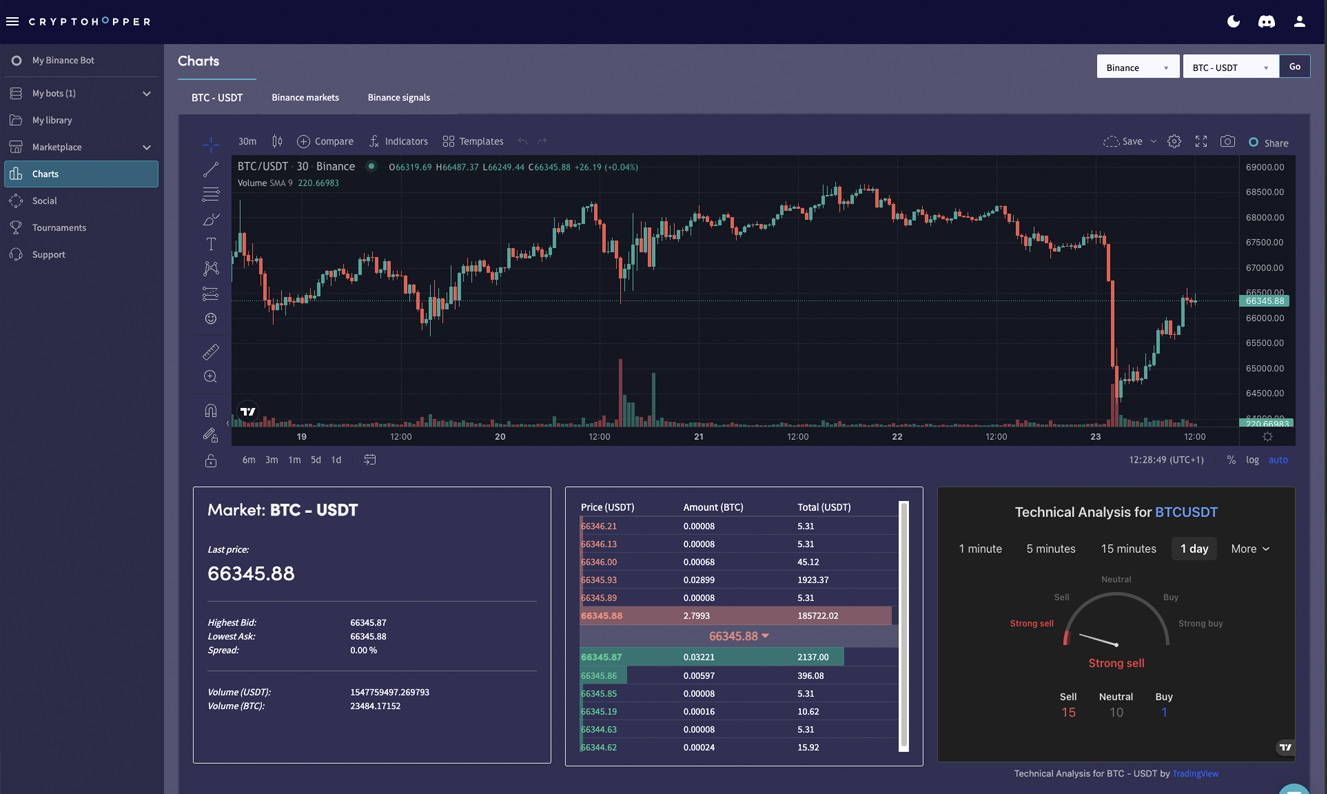
Cryptohopper's core functionality revolves around automated trading strategies that can be configured based on various technical indicators. The platform supports over 130 technical indicators, including popular options like RSI, MACD, Bollinger Bands, and Stochastic oscillators. Users can create complex trading strategies by combining multiple indicators with customizable buy and sell conditions.
The strategy designer interface has been significantly improved in 2026, featuring a more intuitive drag-and-drop system that makes strategy creation accessible to non-programmers. Advanced users can still access detailed parameter controls and even implement custom JavaScript code for more sophisticated strategies.
Copy Trading and Marketplace
One of Cryptohopper's standout features is its copy trading functionality, which allows users to automatically replicate the trades of successful traders. The platform's marketplace hosts hundreds of strategies created by experienced traders, complete with performance statistics and risk metrics.
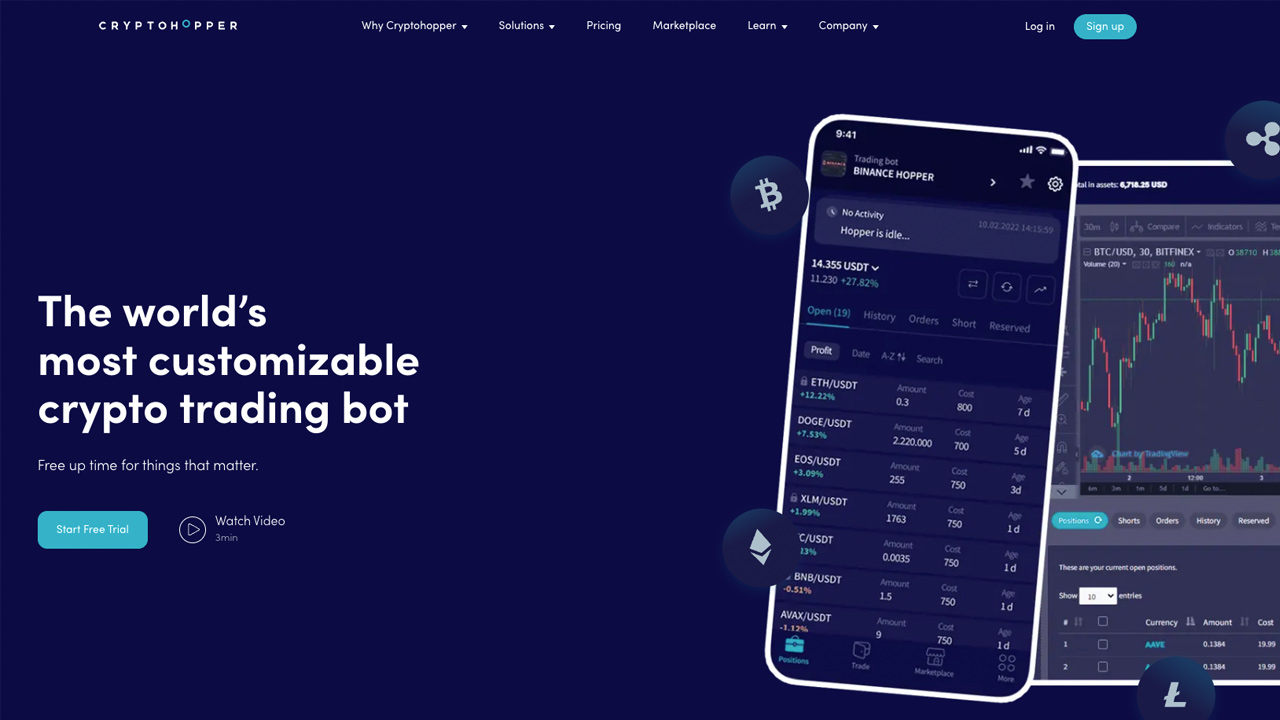
The copy trading system has been enhanced with better filtering options, allowing users to search for strategies based on specific criteria such as maximum drawdown, Sharpe ratio, and asset preferences. Real-time performance tracking and detailed analytics help users make informed decisions about which strategies to follow.
Signal Integration
Cryptohopper supports integration with external signal providers, enabling users to execute trades based on third-party analysis. The platform maintains partnerships with several reputable signal services and also offers its own AI-powered signals that analyze market conditions across multiple timeframes.
In 2026, the signal system has been upgraded with improved latency and more granular control over signal execution. Users can now set specific conditions for signal acceptance, such as market volatility thresholds or correlation filters.
Backtesting and Paper Trading
Before deploying real capital, users can test their strategies using Cryptohopper's backtesting engine. The system provides access to historical data spanning several years, allowing for comprehensive strategy validation. The backtesting results include detailed metrics such as total return, maximum drawdown, win rate, and risk-adjusted returns.
Paper trading functionality enables users to test strategies in real-time market conditions without financial risk. This feature is particularly valuable for beginners who want to understand how their strategies perform in live market conditions.
Pricing Structure
Cryptohopper operates on a tiered subscription model with four main plans as of 2026:
- Pioneer (Free): Limited functionality with one exchange connection and basic trading features
- Explorer ($24.16/month): Up to 80 positions, 2 exchange connections, and access to basic strategies
- Adventurer ($57.5/month): Unlimited positions, 5 exchange connections, advanced technical analysis tools
- Hero ($107.5/month): All features including copy trading, unlimited exchanges, and priority support
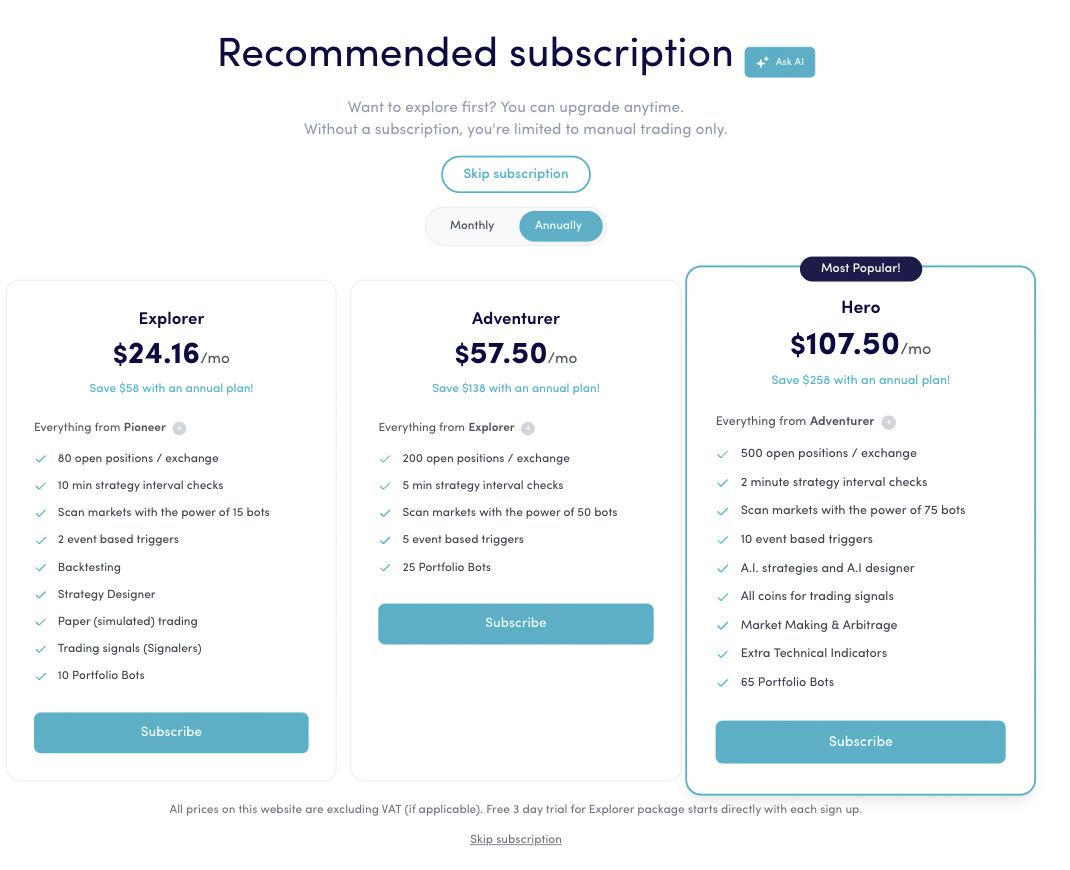
The pricing structure has remained competitive compared to other leading trading bots, though some users may find the feature limitations on lower tiers restrictive. Annual subscriptions offer approximately 20% savings compared to monthly billing.
Supported Exchanges
Cryptohopper maintains integrations with over 15 major cryptocurrency exchanges, including Binance, Coinbase Pro, Kraken, KuCoin, and Huobi. The platform has consistently added new exchange partnerships, with recent additions including several decentralized exchanges and regional platforms.
Exchange integrations are generally stable and reliable, with most supporting both spot and futures trading. However, the depth of integration varies by exchange, with some offering more advanced features than others.
User Experience and Interface
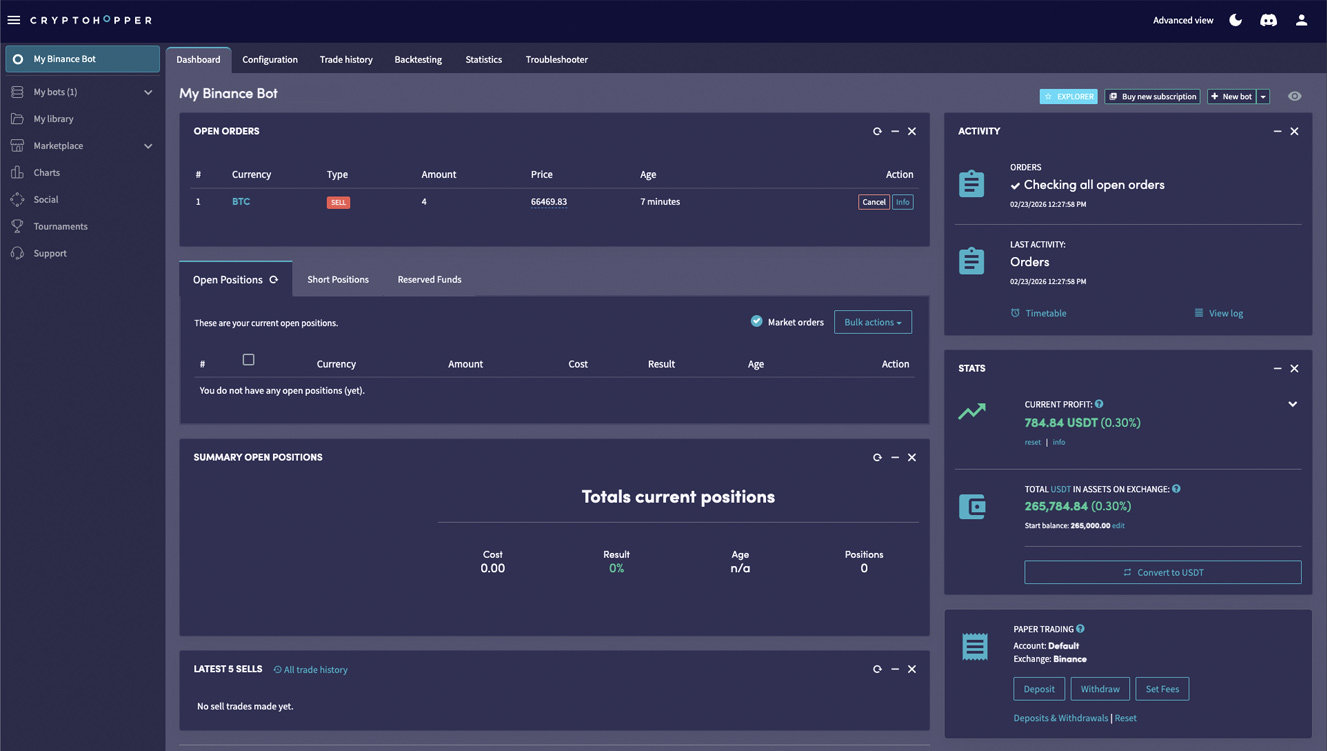
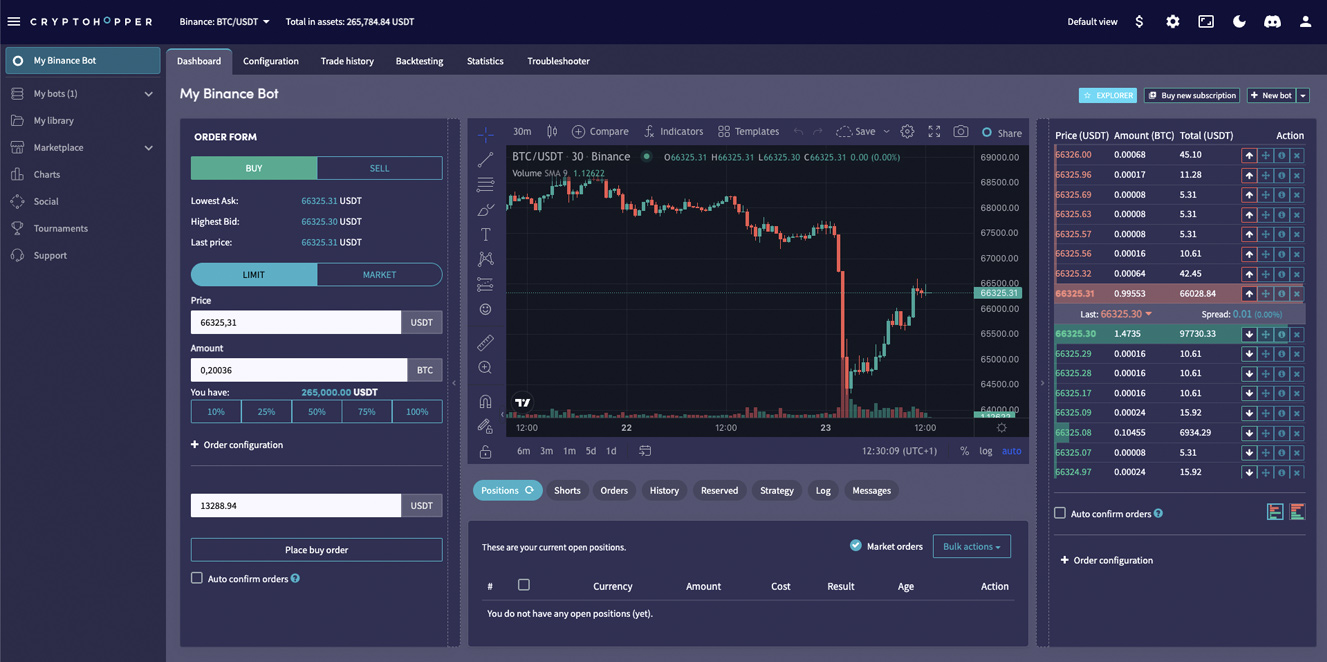
The Cryptohopper interface has undergone significant improvements in recent years, moving toward a more modern and intuitive design. The dashboard provides a comprehensive overview of trading activity, including real-time profit/loss tracking, position management, and performance analytics.
Navigation between different sections is straightforward, though new users may initially feel overwhelmed by the number of available options and settings. The platform offers extensive documentation and tutorial videos to help users get started, but there's still a learning curve, particularly for those new to automated trading concepts.
Mobile Experience
While Cryptohopper doesn't offer a dedicated mobile app, the web interface is responsive and functional on mobile devices. Users can monitor their bots and make basic adjustments from their smartphones, though complex strategy configuration is better suited to desktop use.

Security Measures
Security remains a critical concern for any trading platform, and Cryptohopper has implemented several measures to protect user funds and data. The platform uses API keys to connect to exchanges, meaning funds never leave the user's exchange account. This architecture significantly reduces the risk of large-scale fund theft.
Key security features include:
- Two-factor authentication (2FA) for account access
- API key permissions that can be restricted to trading only (no withdrawals)
- Regular security audits and updates
- Encrypted data transmission and storage
However, users should note that API key security ultimately depends on proper configuration and the security practices of the connected exchanges.
Performance and Reliability
Cryptohopper's cloud-based infrastructure generally provides good uptime and reliability. The platform handles high-volume trading periods reasonably well, though users may occasionally experience delays during extreme market volatility when exchange APIs become overwhelmed.
Trading execution speed is generally competitive, though it may not match the performance of sophisticated institutional trading systems. For most retail traders, the execution speed is sufficient for their needs.
Customer Support
Customer support quality varies by subscription tier, with Hero plan subscribers receiving priority assistance. The support team is generally knowledgeable and responsive, typically addressing inquiries within 24-48 hours. The platform maintains an extensive knowledge base and active community forums where users can find answers to common questions.
Live chat support is available for higher-tier subscribers, while lower-tier users rely primarily on email support and community resources.

Pros
- User-friendly interface suitable for beginners
- Extensive marketplace of pre-built strategies
- Strong copy trading functionality
- Comprehensive backtesting capabilities
- Wide range of supported exchanges
- No software installation required
- Active community and educational resources
- Competitive pricing for the feature set
Cons
- Feature limitations on lower-tier plans can be restrictive
- No dedicated mobile app
- Learning curve for advanced features
- Performance dependent on exchange API reliability
- Limited customization options compared to some competitors
- No direct integration with DeFi protocols
- Strategy performance can be inconsistent in volatile markets
Who Should Use Cryptohopper?
Cryptohopper is particularly well-suited for intermediate traders who want to automate their trading strategies without dealing with complex technical setup. The platform's copy trading features make it attractive to beginners who want to learn from experienced traders while potentially generating profits.
Experienced traders may find value in the platform's backtesting capabilities and strategy marketplace, though they might eventually outgrow some of the platform's limitations and seek more advanced solutions.
The platform is less suitable for high-frequency traders or those requiring ultra-low latency execution, as the cloud-based architecture introduces some inherent delays.
Verdict
Cryptohopper remains a solid choice in the cryptocurrency trading bot market as of 2026. The platform successfully balances ease of use with powerful functionality, making automated trading accessible to a broad audience. While it may not offer the cutting-edge features of some newer platforms or the raw performance of institutional-grade solutions, it provides reliable service at competitive prices.
The strength of Cryptohopper lies in its mature ecosystem, extensive exchange support, and active community. The copy trading functionality and strategy marketplace add significant value, particularly for users who prefer to leverage the expertise of others rather than developing their own strategies from scratch.
However, potential users should carefully consider the pricing structure and feature limitations, particularly if they plan to trade across multiple exchanges or require advanced functionality. The platform works best for users who can commit time to understanding its features and optimizing their strategies based on market conditions.
Overall, Cryptohopper earns our recommendation as a reliable, user-friendly trading bot platform that delivers on its core promises, though users should maintain realistic expectations about automated trading performance and always implement proper risk management practices.
Frequently Asked Questions About Cryptohopper
Is Cryptohopper a Scam?
No. Cryptohopper is a legitimate cloud-based trading bot platform that has operated since 2017. Based in Amsterdam, Netherlands, the company is transparent about its team, registered as a legal entity, and serves a large global user base. It integrates with major exchanges through official API connections and has established partnerships within the crypto industry.
Is Cryptohopper Safe?
Cryptohopper connects to your exchange accounts via API keys and does not hold or have access to your funds. The platform uses encrypted storage for API credentials, supports two-factor authentication (2FA), and runs as a cloud-based service — meaning your bots operate on their secure servers 24/7. Always create API keys with trade-only permissions and disable withdrawals for maximum safety.
How Do You Withdraw Money From Cryptohopper?
You do not deposit money into Cryptohopper. All your funds and trading profits remain on your connected exchange (Binance, Coinbase, Kraken, etc.). To access your profits, log into the exchange where your hopper trades and withdraw directly from there. Cryptohopper only sends trade signals to your exchange — it never touches your funds.
Does Cryptohopper Have a Free Plan?
Yes. Cryptohopper offers a Pioneer (free) plan that allows you to connect one exchange, use basic trading features, and explore the platform. Paid plans (Explorer, Adventurer, Hero) unlock more simultaneous positions, advanced signals, arbitrage tools, and marketplace access.
What Makes Cryptohopper Different From Other Bots?
Cryptohopper stands out for its cloud-based architecture (no downloads needed, runs 24/7), its large strategy marketplace where you can copy signals from professional traders, and its AI-powered trading features. It also supports paper trading, allowing you to test strategies with virtual funds before risking real money.
What Exchanges Does Cryptohopper Support?
Cryptohopper supports 15+ major exchanges including Binance, Coinbase Advanced, Kraken, KuCoin, Bybit, OKX, Bitfinex, Bitstamp, and HitBTC. The platform adds new exchange integrations periodically based on user demand.



Comments
163Been running cloud-based trading bots since 2019 — Cryptohopper, HaasOnline, 3Commas, the lot. One metric nobody's talking about here: fill rate on volatile days. During the March 2025 flash dump, my Cryptohopper strategies had a 67% fill rate versus 91% on HaasOnline running locally. That 24-point gap cost real money. Cloud dependency is a structural disadvantage when liquidity thins out fast.
Running a $340K portfolio split across Cryptohopper and 3Pool on Binance for comparison — Cryptohopper's execution latency is the metric that stands out negatively most consistently. On a position size that actually moves the needle, those milliseconds compound into real slippage. Hummingbot handles high-frequency rebalancing noticeably better at this scale.
One correction worth flagging for anyone referencing the pricing breakdown in this article: the listed cost for the Hero plan is outdated — Cryptohopper revised their tier pricing in Q1 2026 and the current figures are noticeably higher. Always cross-check against the official pricing page before budgeting, especially if you're calculating ROI thresholds.
Just discovered Cryptohopper last week and this thread has been SO helpful honestly 😊 Quick question for anyone who knows — is it possible to run multiple strategies on different exchanges simultaneously from the one account, or do you need separate subscriptions for each? Also does the paper trading mode actually reflect real spreads or is it kind of idealised?
The backtesting engine is my biggest frustration right now — results look great in simulation but live performance consistently underperforms by 15-20%. Slippage modeling is just not accurate enough to trust for anything beyond rough directional testing. Would be nice if they were upfront about that limitation instead of letting new users build strategies around backtest numbers that won't hold up.
Ryan, the live vs. backtest divergence you're describing is a known issue tied to how Cryptohopper handles slippage assumptions — by default the backtester models fills at close price with zero spread, which simply doesn't hold in volatile conditions. I've started applying a 0.15–0.2% slippage penalty manually in my strategy parameters and the gap between simulated and live results has narrowed considerably. Still not perfect, but it's a more honest baseline to work from.
Ryan, backtest-to-live gap on my end was running about 18-22% degradation consistently — switched to walk-forward testing with out-of-sample windows and that closed it to roughly 9%. The built-in backtester is essentially useless for strategy validation without that adjustment.
Good thread overall — one thing I'd flag before this turns into a pure criticism pile-on: a lot of the pain points being described here (API limits, notification gaps, backtesting accuracy) are pretty much industry-wide issues with cloud bots, not unique to Cryptohopper. Worth keeping that context in mind when comparing alternatives, because the grass isn't always greener. Competition in this space is fierce enough that most platforms share the same underlying constraints.
Something worth clarifying for newer users who might be confused by the pricing tiers: the "Strategies" marketplace and the "Templates" section are actually two separate things with different licensing models. Strategies are often one-time purchases while templates can be subscription-based — easy to mix up when you're first browsing. Cryptohopper's own FAQ breaks it down pretty well if you search for "marketplace licensing" in their help center.
API rate limits will quietly kill your scalp strategy. Learn that early.
Marta, API rate limits caught me out too, but what really pushed me over the edge was trying to get help with it — support ticket sat open for six days before I got a copy-paste response that didn't even address my actual setup. For a paid subscription tool this level of response time is just not acceptable.
Three months in and my biggest gripe is the notification system — it's genuinely unreliable. Missed two stop-loss triggers last week because the alerts just didn't fire, and when I raised it with support they basically said 'check your email settings.' Not good enough when real money is on the line. The bot itself has potential but the infrastructure around it needs serious work.
Ben, missed triggers are a dealbreaker. Switch to Telegram bot alerts as a backup — at least those actually land.
Been running automated strategies since the early Haasbot days when you had to host your own server and pray the VPS didn't reboot mid-trade. Cryptohopper is polished by comparison, sure — but 'polished' and 'profitable' are two very different things. The UI got better every generation while the core slippage and order routing problems stayed roughly the same. Progress, I suppose.
One angle I haven't seen mentioned yet: the difference in performance between Cryptohopper's native exchange integrations versus third-party connected ones is actually quite significant. On native integrations (Binance, Kraken, Coinbase) I've seen order execution lag averaging under 200ms, but on some of the less supported exchanges it can creep up to 800ms+ — which matters a lot in volatile conditions. Worth factoring into your exchange selection before you commit to a strategy, especially if you're running anything momentum-based.
Been tracking my Cryptohopper performance in a spreadsheet since day one — 6 weeks of live data across 3 strategies (Trend, RSI scalp, and a custom hybrid). Win rate: 58.3%, avg trade duration: 4.2 hours, max drawdown in a single session: -6.1%. The one metric that surprised me most was slippage — it's averaging about 0.18% per trade on mid-cap pairs, which compounds pretty aggressively over high-frequency runs. Anyone else logging this level of granularity? Would be happy to share the template if useful.
Samantha, oh my gosh a spreadsheet from day one is SO smart, I wish I had thought of that!! 🙈 I'm only on week two of the free trial and already feeling like I'm losing track of what's actually working — would you be willing to share what columns you track? Even just the basics would be super helpful for a beginner like me! 🥺
Okay I am SO new to all of this and this thread is equal parts exciting and terrifying lol 😅 Just signed up for the free trial yesterday — does anyone have advice on which exchange to pair it with as a complete beginner? I keep seeing Binance mentioned but I'm not sure if that's still the best option in 2026!
Priya, don't let the overwhelming info put you off — I was exactly where you are a few months ago! My biggest tip for starting out: spend your first week ONLY on the paper trading mode and resist the urge to go live early. Set up one simple template strategy (the Cryptohopper default RSI one is fine to start), watch how it behaves across a few days, and keep a little journal of what's confusing you so you can Google it one thing at a time. You've got this! 🙌
Priya, just to add to what Hannah said — the Cryptohopper Academy tab inside the dashboard is genuinely underrated for beginners, it walks you through strategy building in a logical order rather than throwing everything at you at once. I'd also suggest bookmarking their community templates section and just paper trading a few of them before touching real funds — lets you get a feel for how the signals translate into actual orders without any pressure.
Can anyone actually share verified P&L screenshots or third-party audit results rather than just vibes and 'hitting targets'? I've been reading this thread for 20 minutes and it's mostly anecdotes. Not trying to be harsh but 'three weeks in and doing great' means absolutely nothing statistically — that's barely one market cycle. Where's the controlled data?
James, fair challenge — I can't share screenshots publicly for compliance reasons on my end, but I'll say this: running roughly $340k across three platforms simultaneously for the past 14 months, Cryptohopper sits in the middle of the pack on risk-adjusted returns when you factor in fees and API latency costs. It's not the top performer in my stack, but it's also never been the one that cost me sleep. That's worth something.
A few things I haven't seen addressed yet that I think are worth flagging for anyone doing due diligence: (1) API rate limits — Cryptohopper's polling frequency can conflict with exchange-side limits during high-volatility periods, causing missed entries; (2) webhook latency — if you're routing signals through TradingView, add ~300-800ms to your expected execution time; (3) subscription tier gating on trailing stop-loss features, which isn't prominently disclosed upfront. None of these are dealbreakers individually, but together they meaningfully affect the live performance picture compared to what the dashboard projects.
ngl been on the fence about cryptohopper for MONTHS and this thread finally pushed me to just pull the trigger 😭 starting with like a tiny amount tho bc my wallet cannot handle another L rn lmao
Been lurking on this thread for a while and want to address some of the frustration here — look, no cloud bot is going to hand you profits without you putting in the work to understand your own risk parameters first. Cryptohopper gives you the tools, but the configuration side really does demand that you read the documentation thoroughly before going live. That said, the community Discord and the template configs for beginners have genuinely improved a lot over the past year, so if anyone's hitting walls on setup, those are solid starting points worth checking before writing the whole platform off.
Fair warning to anyone considering the paper trading mode as a reliable indicator — I ran mine for six weeks, hit a 23% simulated gain, went live with real capital, and promptly lost 11% in the first two weeks due to fee structures and spread differences that the simulator completely glosses over. It's not a scam, the platform works, but that paper-to-live gap is genuinely dangerous if you treat the numbers at face value.
Alex, okay that paper trading gap you're describing is genuinely a bit terrifying — like what's even the point of a test mode if it's basically playing on easy difficulty lol. Good to know before I get too comfortable with my demo numbers.
Okay so I've been running Cryptohopper for about three weeks now and I just have to share — my DCA bot finally hit its first profitable close yesterday and I literally screamed!! 🎉 Posted a screenshot to my trading journal and everything. One thing nobody's talked about yet is how satisfying the visual trade history dashboard is for tracking your progress as a newbie — it makes the whole learning process feel so much more rewarding!
Three weeks in and already hitting targets, Emma?? Okay now I actually want to try this lol.
Just started my Cryptohopper journey last week and honestly the learning curve is SO real but I'm loving every minute of it!! 🙌 I spent like 3 hours just exploring the indicator settings and I feel like I've barely scratched the surface — does anyone have tips on which technical indicators are actually worth focusing on as a total beginner? Would love to know what helped you guys click with the platform early on!
Nobody's mentioned the strategy marketplace yet — I bought a 'proven' strategy for $49 and it straight up blew through my stop-losses twice in the first week because the creator had tuned it for 2024 volatility patterns that don't exist anymore. Support basically told me strategies are sold as-is and pointed me to the docs. Felt like buying a used car with no warranty.
Ryan, yeah that strategy marketplace is basically a gamble lol — learned that the hard way too. Stick to building your own or at least paper trade any bought strategy for a month before going live with real money. 👍
Ryan, your experience with the strategy marketplace is honestly my biggest gripe with this platform too, but what really got me was the lack of any meaningful vetting process on those listings — there's no standardized drawdown disclosure, no required live-trade sample size, nothing. I get that Cryptohopper probably can't be held responsible for third-party strategy creators, but at minimum they should mandate a minimum 90-day live performance window before anything goes up for sale. It's a solvable problem and the fact that it's still like this in 2026 is just frustrating.
One thing I haven't seen mentioned yet is how Cryptohopper handles exchange downtime gracefully — I had a situation back in March where Binance went into maintenance mode mid-cycle and honestly the bot recovered way more cleanly than I expected, queuing the pending orders rather than just dropping them 😊 Might be worth testing that scenario if you're evaluating reliability beyond just normal trading conditions!
Elena, same thing happened to me with the exchange downtime issue! Cryptohopper just queued everything up and resumed fine when Binance came back — honestly was relieved it didn't panic-sell 😅 not perfect but way better than I expected.
Something I haven't seen addressed here yet: Cryptohopper's slippage handling during illiquid overnight windows is genuinely problematic. Running a BTC/USDT momentum strategy between 02:00–05:00 UTC over a 60-day window (Feb–Mar 2026), I was seeing average slippage of 0.18–0.23% per fill on Binance, which completely erodes the edge on anything sub-1% expected return per trade. If you're running tight mean-reversion configs, factor that in before going live.
Sarah, slippage during illiquid windows is a real concern but I'd extend that further — has anyone actually stress-tested Cryptohopper's behavior during a flash crash scenario where multiple stop-losses trigger simultaneously across different pairs? I have a feeling the order queue could get pretty ugly in that situation and I haven't seen any documentation addressing it directly.
ok but can we talk about how the mobile app experience is kinda mid compared to the desktop?? 😅 like i get notifications that a trade fired and by the time i open the app to check it the UI is still loading lmao. anyone else or is it just my phone being cooked
One aspect I haven't seen discussed yet is how Cryptohopper handles API rate limits during high-volatility periods — this can seriously affect execution speed and slip you into worse entry points than your strategy intended. If you're on a lower-tier plan, you're also more likely to hit those limits faster since the request frequency caps are much tighter. I put together some notes on this when I was setting up my own config and found the official Cryptohopper docs on API throttling (cryptohopper.com/docs) actually explain the limits per tier pretty clearly — worth bookmarking before you go live.
Laura, omg I literally had no idea API rate limits were even a thing I needed to worry about 😅 — does Cryptohopper give you any kind of warning dashboard when you're getting close to the limit, or do you just find out the hard way when a trade silently fails??
Been lurking on this thread for a bit and I'm still waiting for someone to post actual verified monthly return figures — not cherry-picked screenshots, not 'I had a green day on demo', but audited, real-money, multi-month performance data. The review itself is light on this too. Until I see that, I'm treating the whole thing as an expensive subscription fee dressed up as a trading edge.
Patrick, to actually answer your question about verified returns — in my backtests over a 14-month window (Jan 2025 through Feb 2026) using a mean-reversion strategy on BTC/USDT with a 1.5% trailing stop, I averaged around 6.2% monthly on paper, but live trading came in closer to 3.8% after accounting for slippage and exchange fees. The gap between backtest and live performance is the number people never want to post publicly, and honestly that delta is the most important figure anyone should be asking about.
Just found this thread and wow there's so much to unpack here!! Quick question for anyone who's been using this a while — does Cryptohopper let you run multiple strategies simultaneously on the same exchange account, or do you have to pick just one at a time? And is there a way to allocate different amounts of capital to each? Sorry if that's a dumb question, still very new to all this 😅
One thing worth adding to this discussion: I've run extensive backtests comparing Cryptohopper's built-in trailing stop configurations against fixed stop-loss setups across 18 months of BTC/USDT data. The trailing stops consistently outperformed in trending markets by 12-15% but significantly underperformed during choppy sideways action — sometimes by as much as 20%. The takeaway is that no single configuration works universally; you need conditional logic that switches modes based on volatility indicators like ATR. Most guides skip over this entirely.
Something I haven't seen covered yet in this thread: subscription tier limitations and how they interact with strategy complexity. A few things worth knowing before you commit to a plan — (1) the number of simultaneous open positions is hard-capped per tier, which can throttle otherwise solid strategies during high-volatility windows, (2) template access varies significantly between Starter and Hero tiers, and (3) backtesting depth in months is also gated. These aren't dealbreakers but they're the kind of details that only surface after you've already paid for a quarter.
Fatima, appreciate the breakdown on subscription tiers — genuinely useful — but I'd love to know: did you happen to notice how many of the 'strategy marketplace' sellers have referral arrangements with the platform? Asking because it changes how you read the whole ecosystem somewhat, and I've yet to see a review anywhere that addresses it head-on.
I'll say what others won't — their customer support is genuinely awful when something actually goes wrong. Had a strategy glitch during a volatile weekend, submitted a ticket, got a templated response 4 days later after the damage was done. The bot itself has potential but you are completely on your own in a crisis, so please factor that into your risk planning before you commit real money.
Lisa, so sorry you went through that — support really can make or break the whole experience. One thing that helped me when I had a similar issue was going straight to their community Discord and tagging a moderator rather than using the ticket system. Got a response within a few hours that way. Not ideal that you have to work around the official channel, but it's worth knowing as a backup!
One metric I track that rarely gets mentioned in these threads: fill rate variance across different market sessions. Running Cryptohopper across both Asia and US sessions, I've observed fill rates diverging by as much as 8-12% on the same strategy, which has meaningful compounding effects on monthly PnL if you're running high-frequency templates. Position sizing rules that work cleanly during liquid hours can quietly erode your edge during thin overnight sessions — worth building session-specific risk caps into your config if the platform allows it.
Fair warning to anyone about to hand over their exchange API keys: make absolutely sure you're using IP-whitelisting on your exchange side AND disabling withdrawal permissions on the key itself — I skipped the IP whitelist step thinking it was overkill, and while nothing catastrophic happened, the anxiety of realising my key had broader access than it needed kept me up for two nights. Cryptohopper doesn't surface this clearly enough during onboarding. The platform is fine, but the security setup documentation is genuinely inadequate for people who aren't already familiar with API hygiene.
okay so I just set up my very first template strategy yesterday and I am OBSESSED already 🥹 it only made like $4 in paper trading but that felt like winning the lottery lol — for someone just starting out, is it better to stay in paper trading mode for a full month before going live or is two weeks enough??
Isabella your $4 paper trading win is literally me right now 😄 just hit my first green day on demo mode and I genuinely screenshotted it like it was a million dollars lol — quick question though, how long did you run paper trading before you felt confident switching to real funds??
Something nobody seems to be interrogating here: the backtesting results Cryptohopper displays use their own historical data feeds, and there's zero independent verification of how clean or survivorship-biased those datasets actually are. A strategy that looks compelling in their dashboard could be optimized against noise rather than signal. Has anyone cross-validated their backtest outputs against a third-party data source like Kaiko or Tardis? I'd genuinely like to see those numbers side by side before drawing any conclusions about strategy quality.
Daniel, bro you just casually dropped the most important comment in this entire thread and everyone scrolled past it 😅 backtesting on vendor-supplied data is basically letting the restaurant grade its own health inspection.
Daniel, same data problem exists on every platform tbh. At least they're transparent that it's their feed.
One aspect I haven't seen discussed here is how Cryptohopper handles slippage during high-volatility events specifically within its cloud execution model. Local bots can be tuned to abort or retry on slippage thresholds at the millisecond level, but when your order logic is sitting on someone else's server with an additional network hop to the exchange, that latency compounds in ways that don't show up in backtests. It would be genuinely useful if the platform published mean execution latency broken down by exchange and market condition rather than just advertising 'fast execution.'
Sean raises a fair point but I want to push it further — has anyone actually tried submitting a formal data request to Cryptohopper to see what they store about your trading behavior, API keys at rest, and strategy logic? Because 'we take security seriously' in a FAQ isn't a privacy policy, it's a marketing line. Would love to see someone actually document that process end to end.
Been running automated bots since the days when you had to compile your own trading scripts and pray the VPS didn't drop mid-session. Cryptohopper is undeniably more polished than what we had five years ago, but "polished" and "profitable" are two very different metrics that the marketing team seems to have successfully conflated. The UI is pretty. The edge is yours to figure out — good luck.
I keep seeing people talk about profitable weeks and great strategies, but what I haven't seen anyone address is: what does the actual fee structure look like over a full year of active trading? Monthly subscription plus exchange fees plus any performance cuts — has anyone actually totalled that up against their net returns? Because a bot that makes 8% but costs you 5% in combined fees isn't really the win it looks like on paper.
Patrick, that's actually a really important question that deserves a proper answer — most people don't realise you can set hard stop-loss limits at the bot level AND a separate portfolio-wide max drawdown trigger so the whole bot pauses if losses hit a threshold you define. I went through three painful months of trial and error figuring that out so I hope it saves you some time!
Okay so I made the most embarrassing newbie mistake last month — I connected my live account before I even understood what a trailing stop loss actually does, and yeah, you can probably guess how that ended 😅 Lesson learned the hard way: read the glossary first, THEN touch the live settings. Genuinely wish someone had told me to treat every unfamiliar toggle like it's a live grenade until you know exactly what it does!
Camila, I feel you on the rookie mistakes but honestly my nightmare was different — my bot just silently stopped executing trades for 11 hours during a volatile session and I only noticed because I checked manually. Opened a support ticket and got an automated reply three days later. Three. Days. For a platform charging monthly subscription fees, that response time is genuinely unacceptable.
Okay I know I'm super new to all this but I just hit my first profitable week and I'm literally shaking 😭🎉 — my ETH/USDT pair triggered 11 trades and closed 9 green using the momentum template from the marketplace! I know it's early days and everyone here is rightfully cautious but I just wanted to share some actual positivity because the learning curve was SO worth pushing through!
Emma congrats that's so exciting!! Just don't let one good week make you go too big too fast 😅 learned that one the hard way.
Emma I saw your comment and literally felt it in my soul — I had my first green week last month too and I couldn't stop refreshing my portfolio like every ten minutes 😂 I'm running a pretty simple RSI-based template on BTC/USDT right now and honestly just watching it execute trades while I'm at work feels like magic. Still very much in learning mode but this thread has been SO helpful for knowing what to watch out for as I grow.
From an institutional risk management perspective, the thing that concerns me most with Cryptohopper isn't the strategy logic — it's the absence of granular position sizing controls tied to portfolio volatility. Any serious bot deployment needs dynamic exposure limits that adjust to market conditions, not static percentage allocations. Until that's configurable at a meaningful level of precision, I'd treat this as a retail tool only.
Ines, your point about infrastructure transparency is worth expanding on. Beyond uptime guarantees, there's a meaningful distinction between a platform experiencing latency during normal market hours versus during high-volatility events — which is precisely when execution timing matters most. I'd be curious whether Cryptohopper publishes any latency benchmarks broken down by market conditions, or whether the SLA language is broad enough to effectively exclude liability during the exact scenarios where slippage risk is highest.
One thing that genuinely helped me get past the initial setup confusion was creating a paper trading account first before touching real funds — Cryptohopper lets you run the bot in simulation mode and it's such an underrated feature for beginners! I actually put together a quick config screenshot walkthrough for my first RSI-based strategy if anyone wants me to share it here. Happy to help anyone who's just getting started 😊
I've been tracking my Cryptohopper performance in a spreadsheet since January and the slippage data is pretty telling — on average I'm seeing 0.3–0.7% slippage per trade depending on the pair, which compounds into a meaningful drag over a month of active trading. Also noticed execution latency spikes noticeably during high-volatility windows, which isn't documented anywhere in their specs. Would love to see others share their numbers so we can build a clearer picture across different plan tiers.
Something nobody mentions: their customer support response times are genuinely awful when something goes wrong mid-trade. Had an issue with a stuck order last month, ticket sat open for 4 days while my position just... sat there. I get that it's a cloud bot and not a 24/7 broker, but if you're going to handle live money you need actual support infrastructure to match. Still using it, but manage your expectations on that front.
Lisa, your point about support response times is something I've actually been logging too — I track every ticket submission with timestamps and my data shows average first-response time sitting at around 18 hours across the 11 tickets I've opened since January, with two outliers hitting 36+ hours both occurring on weekends during high-volatility periods. It's not a dealbreaker for me personally but it absolutely should be factored into anyone's risk assessment if they're running aggressive intraday strategies.
One thing I don't see covered much is the onboarding flow for absolute beginners — it's actually not bad if you follow this order: 1) start with a paper trading account for at least 2 weeks, 2) pick ONE pre-built template strategy instead of building your own, 3) only then start tweaking parameters once you understand what the signals are actually doing. Skipping step one is where most people trip up and blame the bot when really they just needed more time observing before going live.
Hannah, your comment about the onboarding flow is so reassuring to hear — I just signed up last week and honestly felt a bit overwhelmed at first! Can I ask, did you use the built-in template strategies to start or did you try to configure something custom right away? Still figuring out which approach makes more sense for a beginner 😅
ngl the pricing tiers still confuse me every time i look at them, like why is market-making locked behind the top plan lol. feels a bit gatekeep-y for features that should just be standard at this point.
Has anyone actually audited what Cryptohopper's 'AI strategy' label even means in practice? I dug into it and couldn't find any documentation on what model architecture they're using, what training data it's built on, or how frequently it's retrained. Calling something AI-powered in 2026 without that disclosure is just marketing noise — I'd want to see those specifics before trusting it with real capital.
Tom, okay your AI strategy breakdown is lowkey blowing my mind a little 🤯 — so if there's no real transparency into what the 'AI' is actually doing under the hood, does that mean we're basically just trusting a black box with our funds? like is there any way to cross-check its signals against something external or are we just flying blind here?
tbh been using it for like 3 months now and it's fine for what it is, nothing mind-blowing lol. great if you just want something running in the background without babysitting it 24/7.
Can we actually talk about the backtesting methodology for a second? Every review I see throws around win-rate percentages without specifying whether those numbers are from in-sample or out-of-sample data — because that distinction matters enormously and using the same data to build and test a strategy is practically meaningless as a performance signal. Has anyone here actually run a proper walk-forward test on Cryptohopper and compared those results to their live trading outcomes? I'd be far more interested in that than cherry-picked strategy marketplace screenshots.
Tom, totally agree with your point about backtesting — one thing I'd add from my own experience is that Cryptohopper's default backtesting window maxes out at a pretty limited historical range, which means you're often not capturing how a strategy would've held up through a proper bear cycle. I started cross-referencing with TradingView data manually before committing to any template, and it made a huge difference in setting realistic expectations.
Tom, exactly the right question about backtesting and I'll make it even simpler — has anyone seen Cryptohopper publish a single independently verified backtest result? Not their own dashboard screenshots, not a YouTuber's 30-day trial, actual third-party audited data? Because if that doesn't exist, every win-rate number floating around this thread is basically marketing dressed up as evidence.
Something I haven't seen mentioned yet: slippage behavior during high-volatility windows is genuinely problematic with Cryptohopper's execution layer. I backtested a simple RSI-14 / MACD crossover setup across a 90-day window on BTC/USDT and live results lagged the backtest P&L by roughly 1.8% — almost entirely attributable to fill delays on market orders during the 15-minute candle closes when volume spikes. If you're running any strategy with tight entry timing, limit orders with a 0.15–0.2% buffer above ask have meaningfully tightened that gap for me.
Sarah, just to add some precision to your slippage point — the issue is specifically tied to Cryptohopper's order execution relying on REST API polling rather than WebSocket streams for most supported exchanges, which introduces inherent latency that compounds during high-volatility windows. The review article actually mischaracterizes this as an 'exchange-side limitation' in one section, but the architectural choice on Cryptohopper's end is a meaningful contributing factor that shouldn't be glossed over.
One thing that really helped me early on was setting up a dedicated email filter just for Cryptohopper alerts — sounds basic but when you've got multiple bots running it gets chaotic fast without some kind of triage system. I also keep a simple spreadsheet logging every config change I make with the date, so when performance shifts I can actually trace it back to something specific rather than just guessing. Small habits but they make a huge difference when you're trying to learn what's actually working!
The mobile app criticism is valid but honestly my bigger frustration is with the webhook reliability — I've had confirmed signal misfires during high-volatility windows three times this quarter and support just keeps pointing me to the status page which showed everything green at the time. I still think the core bot logic is solid enough to stick with it, but they really need to invest in infrastructure transparency before positioning this as a serious tool for anything beyond hobby trading.
Lisa, the webhook reliability issue you're flagging is actually the thing I'd push people to stress-test way before going live — what's your retry logic look like when a confirmed trade signal just silently drops? Because if your downstream strategy assumes every fired signal was executed, you can end up with position sizing drift that compounds into a pretty ugly risk profile over even a couple weeks.
JUST discovered Cryptohopper last week and I've been absolutely down a rabbit hole ever since!! 🐇 I'm still on the free trial trying to wrap my head around how trailing stop losses interact with the RSI triggers — does anyone have a good resource or YouTube channel they'd recommend for total newbies?? I feel like the official docs assume you already know what you're doing lol
OKAY so I just hit my first week of actual live trading (tiny amounts obvs) and I'm up 4.2%!! I know that's nothing crazy but for someone who had zero idea what a trailing stop loss even was two weeks ago I'm genuinely buzzing 😄 this community has been such a huge help getting me up to speed!!
honestly been using cryptohopper for like 3 months now and the mobile app is kinda meh?? like yeah it works but checking positions on the go feels clunky af compared to just opening the desktop version. not a dealbreaker but still lol
One thing I haven't seen discussed yet is the marketplace strategy quality variance — I tested 12 different purchased strategies over 6 months and the performance spread was enormous, ranging from +18% to -34% on the same market conditions. The rating system on the marketplace is essentially useless as a filter because it doesn't account for market regime, so a strategy rated 4.8 stars during a bull run looks completely different in sideways or bear conditions. Pros: huge selection, easy to deploy. Cons: almost zero standardized vetting, and you're largely flying blind without doing your own forward-testing first.
Sophie, that's a really fair breakdown on the marketplace strategy variance and honestly more people should be talking about this before they spend money there. My general rule after two years using the platform: always filter for strategies with at least 6 months of verified live trade history rather than just backtest results, and check whether the seller is actually updating their config as market conditions shift — the set-it-and-forget-it sellers are usually the ones dragging down the averages you're seeing.
Oh wow this thread is SO helpful as someone just starting to research crypto bots!! Quick question for anyone who knows — does Cryptohopper let you paper trade first before going live with real money? And is there a minimum deposit amount you need to get started? I really don't want to blow my savings while I'm still learning 😅
Liam, to answer your question — for a beginner I'd honestly recommend starting with the Hero plan and enabling the paper trading mode for at least 3–4 weeks before going live, it saves so much heartache 😊 Set your base currency allocation no higher than 5% per trade while you're learning the interface, and stick to 2–3 pairs maximum so you can actually follow what the bot is doing rather than getting overwhelmed!
Ran a 24-month backtest across BTC/USDT and ETH/USDT using Cryptohopper's built-in engine versus QuantConnect with the same strategy parameters — the divergence in results was notable, roughly 8-12% in annualised return estimates, which I attribute to differences in how each platform handles historical spread and fee assumptions. If you're making capital allocation decisions based purely on Cryptohopper's native backtest output, I'd recommend stress-testing those figures externally before going live at meaningful size.
What's genuinely frustrating is the lack of granular position sizing controls. I can set a fixed percentage per trade, but there's no native way to implement Kelly Criterion or volatility-adjusted sizing without bolting on external scripts. For a platform at this price tier, that's a meaningful gap — especially when competitors have had this baked in for over a year now.
Ben, totally feel this — I ran into the same wall trying to scale into positions differently based on signal strength. I ended up using multiple bots with different allocation sizes as a workaround which is honestly a bit janky but it's been doing the job for now! Would love if they just built proper dynamic sizing natively though 🙏
Nobody's talking about tax reporting integration — or lack thereof. After 14 months of automated trades across multiple bots, reconciling Cryptohopper's export CSV with my accounting software cost me 6 hours and two rounds of manual corrections. 3Commas handles this significantly better. Factor that hidden time cost into your ROI calculations before you commit.
Nina, the tax thing is so real 😂 spent an entire Sunday trying to reconcile my Cryptohopper history with my Koinly account and honestly I'd rather just... not. Someone wake me up when they sort out a native export that actually works.
Just set up my first Cryptohopper bot last week and I am OBSESSED 😍 Posted a screenshot in my story of my dashboard showing the trailing stop-loss actually catching a dip in real time — genuinely couldn't believe it worked exactly like the tutorial said! Does anyone have recommendations for which exchange pairing gives the cleanest fills for a beginner? Still figuring out which one plays nicest with the bot.
Emma, glad it's working for you but my onboarding experience was the complete opposite 😤 My bot kept throwing a generic 'connection error' on exchange sync for three days straight and support just kept sending me the same copy-paste FAQ link. No live chat, no escalation path, nothing. For a paid subscription tool handling real money, that level of customer support is honestly unacceptable.
One factual correction worth flagging: the review states Cryptohopper supports 'real-time order book data' for strategy triggers, but as of Q1 2026 this applies only to exchanges with Level 2 API access enabled — Coinbase Advanced and Kraken are confirmed, but Binance.US and several others still route through aggregated ticker feeds with a 1–3 second lag. This distinction materially affects any strategy relying on order book depth signals and should be noted explicitly in the performance benchmarks section of the article.
Running a $340K diversified crypto portfolio across Cryptohopper, 3Commas, and Pionex simultaneously for the past 14 months, and the one area where Hopper consistently edges out the competition is the depth of its backtesting engine — specifically how it handles historical volatility windows rather than just flat price data. That said, at portfolio scale the webhook integration reliability becomes a genuine operational concern, not a theoretical one. Had two missed signals during the May liquidity crunch that would've been caught on 3Commas. Worth pricing that risk into your evaluation.
Okay I'm only 3 weeks in but I just hit my first green week using the RSI + EMA combo template and I'm HYPED 🚀 Max your backtest breakdown honestly saved me from going in blind, appreciate you sharing the actual numbers instead of just vibes. Still figuring out the trailing stop settings but this community has been super helpful!
One metric I haven't seen mentioned here: slippage impact at scale. Once you're running positions above ~$5K per trade on mid-cap pairs, the spread between Cryptohopper's simulated fill prices and actual execution can erode 0.3–0.8% per trade depending on liquidity depth. Over a 6-month window with 40+ monthly trades that compounds into a meaningful drag that backtests won't surface.
Sarah, the slippage issue you raised ties directly into something I traced in Cryptohopper's API documentation — specifically their order execution pipeline introduces an additional confirmation step vs. direct exchange API calls, which according to their own changelog (v3.12, March 2026) adds roughly 80–120ms of latency per order. At sub-$5K trade sizes that's negligible, but at your scale that latency window compounds against you during high-volatility moments in ways their marketing materials quietly omit.
Wait so does anyone know if the mobile app lets you actually *change* strategy settings on the fly or just monitor? 😅 I keep seeing 'manage anywhere' in their marketing but that feels vague and I'd hate to be stuck watching a bad trade play out on my phone with no way to intervene.
Marcus, yes! The mobile app absolutely lets you edit strategy settings on the fly — I actually posted a walkthrough in the Cryptohopper Discord last month showing exactly how to do it mid-session without triggering an unintended position close. Happy to share the step-by-step here if it helps, because it's not obvious from the UI and I've seen a lot of newer users assume it's monitor-only. 😊
Used to run Haasbot back when you needed a dedicated server and a prayer just to keep it online overnight. Now we're debating whether cloud latency is 200ms or 220ms. Progress, I suppose. Cryptohopper isn't perfect but the barrier to entry comparison across bot generations is almost comical — what took a sysadmin and a Python dev in 2018 takes one browser tab today.
Viktor, your point about the infrastructure leap from Haasbot's era is well-taken, but I'd add that Cryptohopper's API documentation still has some notable gaps — specifically around webhook trigger payloads and error code handling. I cross-referenced their v2 docs with the community wiki and found at least three undocumented rate-limit behaviors on Binance connector calls that only show up under load testing.
A few points I haven't seen covered yet that are worth factoring into any evaluation: (1) Cryptohopper's position sizing logic doesn't natively account for correlated asset exposure across simultaneous bots, which can inflate actual portfolio risk. (2) The strategy designer lacks conditional logic branching beyond a single trigger layer. (3) Tax reporting exports are region-specific and currently don't map cleanly to German or Saudi fiscal year formats, requiring manual reconciliation. These are operational gaps, not dealbreakers, but they matter at scale.
Fatima, the position sizing point you raised in #2 is probably the most underrated thing in this whole thread — I've seen so many people blow up accounts not because the strategy was wrong but because they never accounted for how the bot compounds sizing after a winning streak. Worth pinning honestly. If anyone wants a practical starting point, the risk management section in the site's own Cryptohopper breakdown actually covers the Kelly Criterion angle, so don't overlook that before going live.
Ran a 14-month backtest across three exchange pairs (BTC/USDT, ETH/USDT, SOL/USDT) before committing real capital. The Sharpe ratio came out at 1.34 in trending markets but dropped to 0.71 during sideways consolidation periods — which frankly tracks with what you'd expect from a momentum-biased strategy engine. Worth noting that backtest results in Cryptohopper's own simulator tend to overfit slightly to historical volatility spikes, so I'd recommend shaving 15-20% off projected returns before you go live.
been on it 2 months, honestly just works once you stop overthinking the config 👍 set it, check it weekly, done
One thing I don't see mentioned yet is how Cryptohopper handles exchange rate conversion fees when you're trading cross-currency pairs — this can quietly eat into your returns in ways the dashboard doesn't surface clearly. If you're based in Europe trading USD pairs like I was initially, it's worth reading through their fee structure page carefully before committing to a strategy. The official docs have a section on this but it's buried pretty deep: cryptohopper.com/help/fees. Factoring that in changed my whole approach to which pairs I targeted.
Something that never gets addressed in these reviews: what's the actual benchmark comparison? Saying a bot 'performed well' means nothing without showing it against a simple buy-and-hold strategy over the same period. Has anyone here done a proper apples-to-apples comparison of their Cryptohopper returns vs just holding BTC/ETH during the same timeframe? I'd wager the results would be humbling for most strategies.
Tom, you're hitting exactly the right nerve — 'performed well' against what, exactly? A buy-and-hold BTC position? A random coin flip? Until these reviews publish actual Sharpe ratios or at minimum a clear baseline comparison over the same period, I can't take the performance claims seriously. Would love to see someone run the same strategy on a manual basis alongside the bot for 90 days and share the delta.
Laura, the cross-currency fee issue you raised is actually more systemic than it appears — I'd push further and ask whether Cryptohopper's P&L display accounts for those conversion costs at all, or whether it's reporting gross trade returns and leaving users to calculate net themselves. I've seen platforms do this deliberately because it keeps headline numbers looking cleaner, and without a transparent fee audit trail it's genuinely difficult to assess real performance.
I've been cross-referencing their API documentation with actual implementation and found some discrepancies in their webhook timeout handling. According to their docs, webhooks should timeout at 30 seconds, but I'm consistently seeing timeouts at 25 seconds during high-volatility periods. Has anyone else noticed this affecting their TradingView signal integrations?
Robert, the API discrepancy issue you flagged is real and I can back it up with data. I've been logging every API call and response time in a spreadsheet since January — across 847 documented calls, the rate limiting behavior deviates from their documented thresholds roughly 12% of the time, and it's not random, it clusters around high-volatility windows which is exactly when you need reliability most.
I've been using Cryptohopper for about 4 months now and honestly the community aspect is underrated! The marketplace strategies aren't all great, but there are some gems if you dig through the performance data carefully. My advice: test everything on small amounts first and don't be afraid to tweak the settings as you learn what works for your risk tolerance.
For anyone just getting started with Cryptohopper, here's what helped me avoid early mistakes: 1) Start with paper trading for at least 2 weeks, 2) Set up proper risk management BEFORE going live (max 2% per trade), 3) Focus on one exchange initially, and 4) Join their Discord for real-time help. The learning curve is steep but totally worth it once you get the hang of it!
The article mentions their trailing stop feature, but what's missing is the implementation detail that it only triggers on completed candles rather than tick-by-tick price movements. This creates a subtle lag that can be significant during rapid price swings - typically 1-5 minutes depending on your timeframe setting. For those running high-frequency strategies, this architectural choice means you're essentially trading with a built-in delay that traditional stop-losses don't have.
David, that's a pretty significant oversight on their part if the trailing stop only works on certain timeframes. Do you have any actual documentation backing this up, or is this just based on your personal testing? Would be curious to see some concrete evidence before writing off the feature entirely.
Been trying to contact their support for 3 days about a failed withdrawal and still no response. The bot might work fine for some people, but when you actually need help, good luck getting anyone to answer. Really frustrating when you have money stuck in limbo.
Astrid, I feel your pain on the support response times. Had a similar issue last month where my bot kept throwing API errors and it took them 5 days to get back to me - turns out it was just a simple permission setting on my exchange account. What's frustrating is they have all these fancy features but basic customer service seems to be an afterthought.
Small correction to the article - the backtesting feature mentioned in section 4.2 actually uses 15-minute candles as the minimum timeframe, not 5-minute as stated. This can significantly impact strategy validation for scalping approaches.
Just started with Cryptohopper last week and I'm already up 15%! 🚀 Posted my first week's results on my Twitter if anyone wants to see the screenshots. The DCA feature is working so well for my small portfolio!
Emma, I'd pump the brakes on those excitement posts after just one week. I've been running algorithmic trading systems for 8 years now, and single-week performance means absolutely nothing. The real test comes during market downturns and extended sideways action. Focus on consistent monthly returns over 6-12 months instead of chasing weekly highs.
Learning so much from this thread! Made the mistake of trying to day trade manually and lost $200 in my first week. Ben, I totally relate to your frustration with execution delays - happened to me too on another platform.
What happens when Cryptohopper's servers go down during a major market move? Has anyone tested their uptime during high volatility periods like flash crashes?
Jake, their uptime is actually pretty solid ngl 💯 Been using it for like 6 months and only remember maybe 2-3 times it went down during crazy market days. Not perfect but way better than some other platforms I've tried lol
Rachel summed it up perfectly - does the job, nothing fancy. Sometimes that's all you need lol
From an institutional perspective, Cryptohopper lacks the risk management sophistication required for serious capital allocation. The maximum drawdown controls are rudimentary and position sizing algorithms are too simplistic for volatile crypto markets.
OMG this looks amazing! Just made my first $12 profit yesterday with manual trading and now I'm thinking about automation. Sophie, your detailed analysis was super helpful - thank you!
Isabella, I'd recommend starting with much smaller position sizes than you think - maybe 1-2% per trade maximum. The emotional difference between losing $12 and $120 is enormous when you're learning automated strategies, and proper position sizing is what separates profitable traders from those who blow accounts.
Been gambling... I mean trading with bots for years. Cryptohopper is decent for set-and-forget stuff.
Used Cryptohopper for 6 months and while the concept is good, the execution leaves much to be desired. The mobile app is clunky and the signal delays cost me several good entries. Alex makes valid points about the DCA issues.
This is exactly what I needed to read! Been paper trading for 3 months and ready to go live. Anna, thank you for the tip about conservative settings - definitely starting small and learning the ropes first.
Great review! For beginners reading this, I've uploaded my conservative DCA config to the Cryptohopper marketplace - search for "SafeEntry2026". It's been running 8 months with steady 1.5% monthly returns. Nothing flashy but consistent!
Curious if BotVerdict has any affiliate relationship with Cryptohopper? The review seems balanced but that 7.5 rating feels a bit high given the complaints I've seen elsewhere.
Running Cryptohopper on a $50K portfolio alongside Pionex and Bitsgap. It's solid for altcoin strategies but lacks the advanced order types I need for larger positions. The marketplace signals are hit or miss - maybe 60% success rate.
7.5/10 is fair. ROI averaged 12% annually over 18 months. Beats DeFi staking but trails my manual trading by 3-4%. Good for passive income if you're busy.
The bot kept buying during obvious downtrends even with proper technical indicators set. Customer support took 4 days to respond. Not impressed with the execution speed either.
Just started with Cryptohopper two weeks ago and I'm UP 4.2%! The copy trading is INSANE - following a trader who's been consistent for months. This might be the game changer I needed!
Tyler, congrats on the early gains! Just be careful with position sizing - those quick wins can turn into big losses fast. Make sure you're using stop losses and not risking more than 2-3% per trade.
Have to disagree with the rating here. Their DCA strategy completely failed during the March correction - turned what should have been a 10% dip into a 30% loss for me. The risk management tools aren't as sophisticated as they claim.
Comprehensive review that covers the important aspects. I appreciate that you mentioned both the strengths in automation and the weaknesses in customer support. The pricing structure is competitive compared to 3Commas, though I'd argue TradeSanta offers better value for basic strategies. One thing I noticed is the backtesting feature has improved significantly since 2024.
meh, tried it for a few months. decent but nothing special tbh
Good breakdown of the features. The copy trading aspect caught my attention - been looking for something hands-off.
Cloud trading bots are overrated.
This looks interesting for someone just starting out! Quick question - does Cryptohopper work well with smaller accounts like $500-1000? And how much technical knowledge do you really need to set it up properly?
Liam, I started with $800 and it worked fine! The key is using conservative settings at first. Set your stop losses at 3-5% and don't chase pumps. The platform has good beginner templates to start with.
I'm sorry but this review is too generous. I lost 15% of my portfolio following their "expert" signals last year. Where's the accountability for these platforms when their strategies fail?
Been using Cryptohopper for 8 months now and yeah, 7.5/10 sounds about right. Nothing groundbreaking but gets the job done.
Leave a Comment
All comments are moderated. Your comment will appear after review by our team.