

Overview: What is Pionex?
Pionex has established itself as a unique player in the crypto trading space by combining a centralized exchange with built-in automated trading bots. Founded in 2019 by BitUniverse, this Singapore-based platform offers 16 different trading bots designed to help both beginners and experienced traders automate their cryptocurrency strategies.
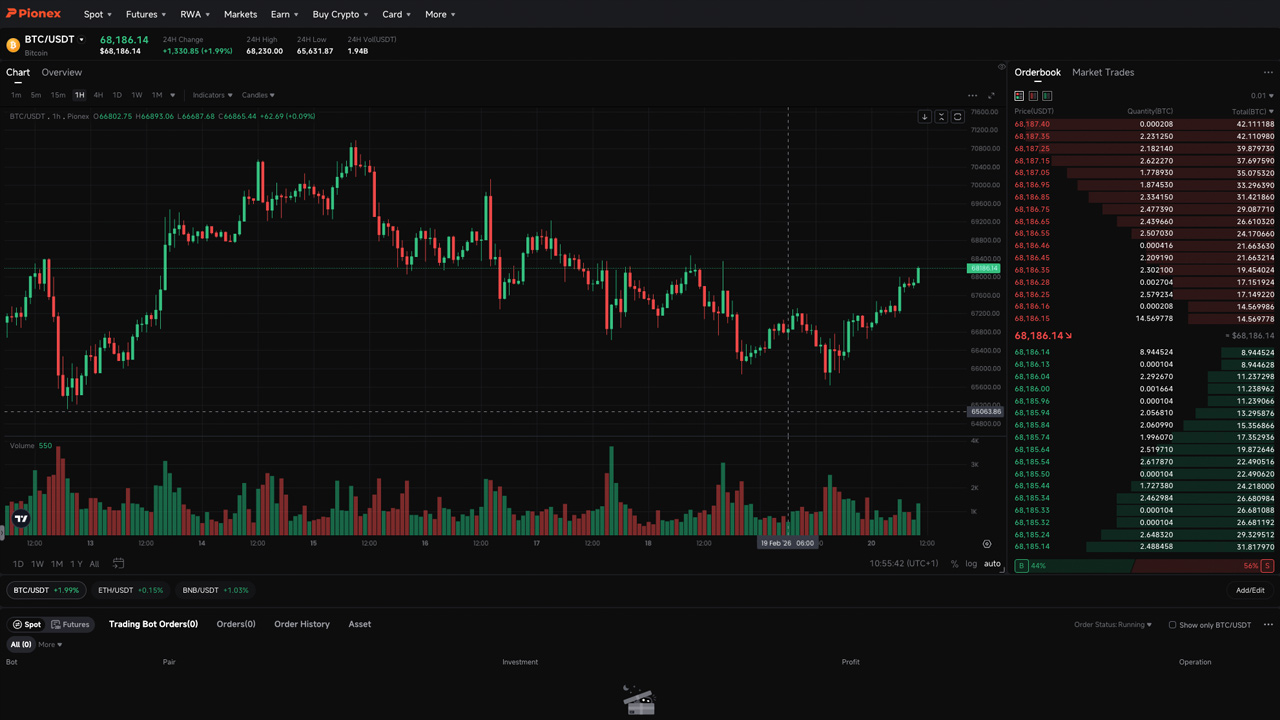
Unlike traditional trading bot services that require connecting to external exchanges, Pionex operates as both the exchange and the bot provider. This integrated approach eliminates the need for API connections and reduces the complexity typically associated with automated trading setups.
As of 2026, Pionex has grown significantly, serving over 2 million users worldwide and processing billions in trading volume. The platform's focus on grid trading and dollar-cost averaging (DCA) strategies has resonated particularly well with retail investors looking to navigate volatile crypto markets.
Key Features and Trading Bots
Grid Trading Bots
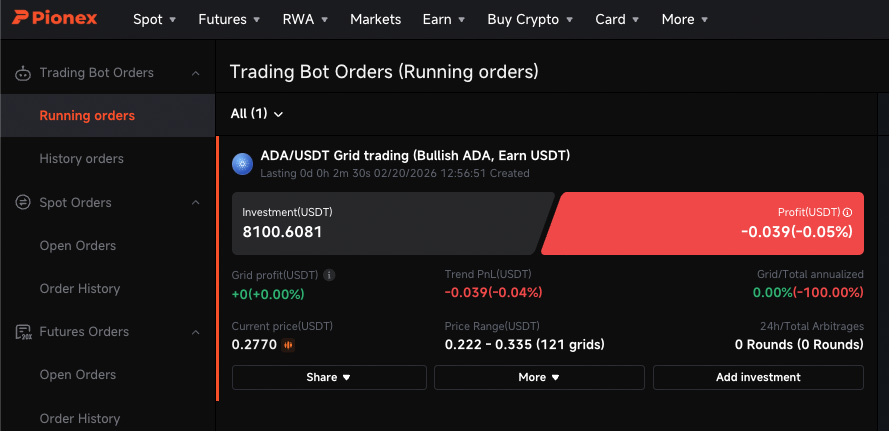
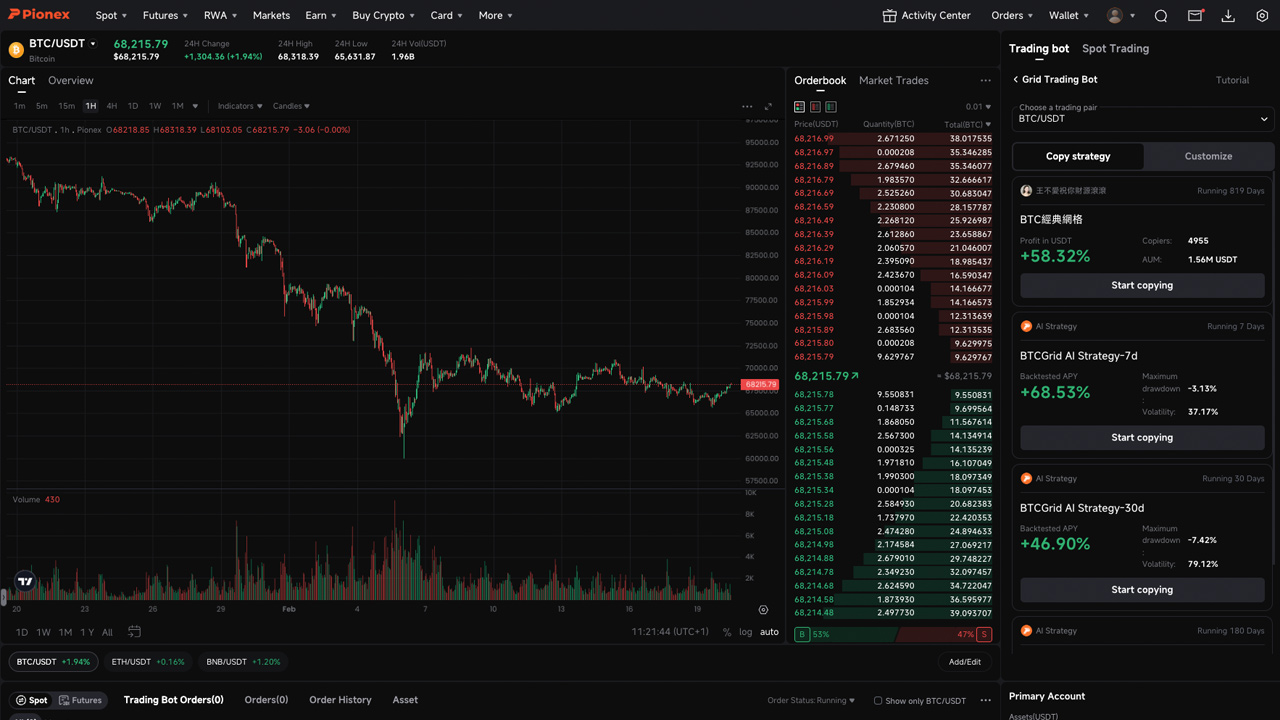
Pionex's flagship feature is its grid trading system, which automatically places buy and sell orders within a specified price range. The platform offers several grid bot variations:
- Spot Grid: Basic grid trading for spot markets with customizable price ranges and grid numbers
- Futures Grid: Leveraged grid trading with up to 20x leverage for more aggressive strategies
- Infinity Grid: No upper price limit, designed for long-term bull markets
- Reverse Grid: Optimized for bear markets and downward price movements
DCA and Investment Bots
Beyond grid trading, Pionex provides several investment-focused bots:
- DCA Bot: Systematic dollar-cost averaging with flexible scheduling
- Smart Trade: Advanced order types including take profit and stop loss
- Rebalancing Bot: Portfolio rebalancing across multiple cryptocurrencies
- Martingale Bot: High-risk, high-reward strategy doubling down on losing positions
Advanced Features
The platform includes several sophisticated tools that set it apart from competitors:
- Copy Trading: Follow successful traders' strategies automatically
- Leveraged Tokens: Gain leveraged exposure without managing positions
- Spot-Futures Arbitrage: Exploit price differences between spot and futures markets
- Auto-Invest: Recurring purchases with built-in rebalancing
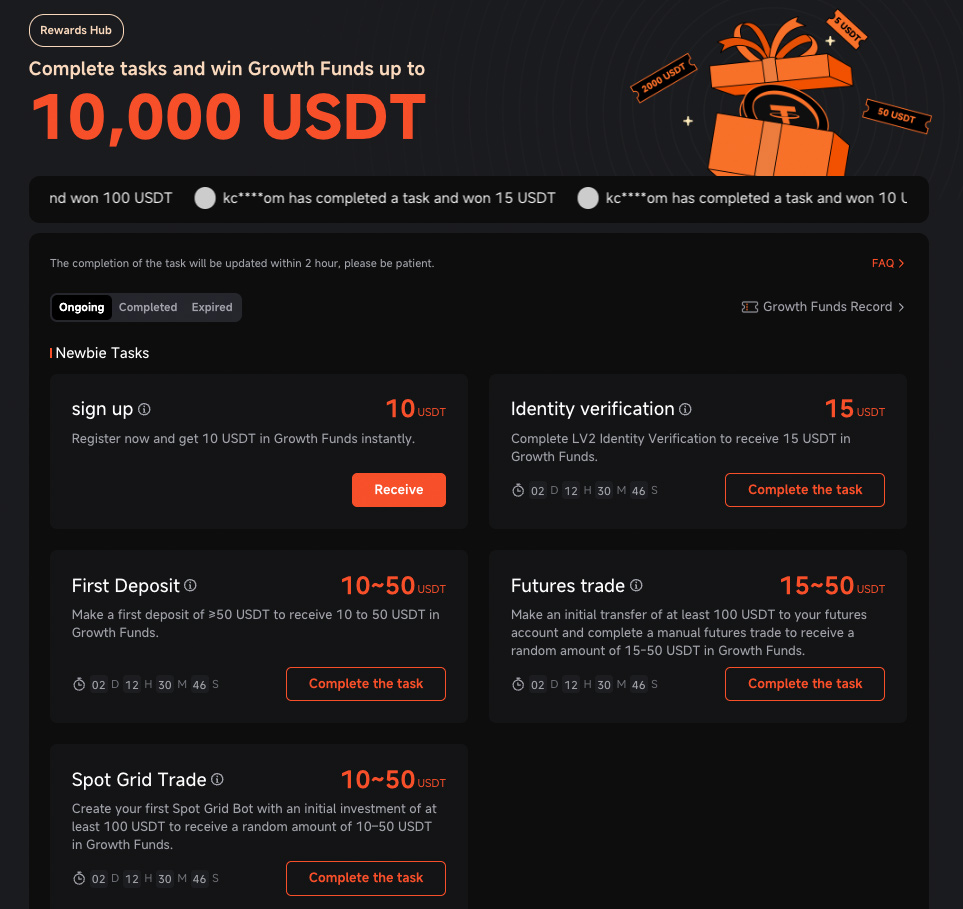
For new users looking to get started, Pionex regularly offers promotional campaigns and deposit bonuses. These initiatives, such as special deposit matching programs, can help traders increase their initial capital and experiment with different bot strategies without significant upfront investment.

Pricing and Fee Structure
One of Pionex's most attractive features is its competitive fee structure. The platform operates on a maker-taker model with some of the lowest fees in the industry:
Trading Fees
- Spot Trading: 0.05% for both makers and takers
- Futures Trading: 0.05% makers, 0.05% takers
- Bot Trading: No additional fees beyond standard trading fees
Additional Costs
- Withdrawal Fees: Vary by cryptocurrency, generally competitive with industry standards
- Funding Fees: Standard rates for futures positions held overnight
- Premium Features: Most bot features are free; some advanced analytics require higher VIP levels
The absence of separate bot fees is particularly noteworthy, as many competing platforms charge additional subscription fees for automated trading features. This makes Pionex especially cost-effective for active bot users.
User Experience and Interface
Platform Design
Pionex's interface strikes a balance between functionality and simplicity. The web platform features a clean, modern design with intuitive navigation between trading, bot management, and portfolio sections. The mobile app mirrors the web experience effectively, allowing full bot management on the go.
Bot Setup Process
Setting up trading bots on Pionex is remarkably straightforward:
- Select the desired bot type from the bot marketplace
- Configure parameters like price range, investment amount, and grid quantity
- Review AI-generated suggestions for optimal settings
- Launch the bot with a single click
The platform provides helpful tutorials and suggested parameters for each bot type, making it accessible even to trading beginners.
Performance Monitoring
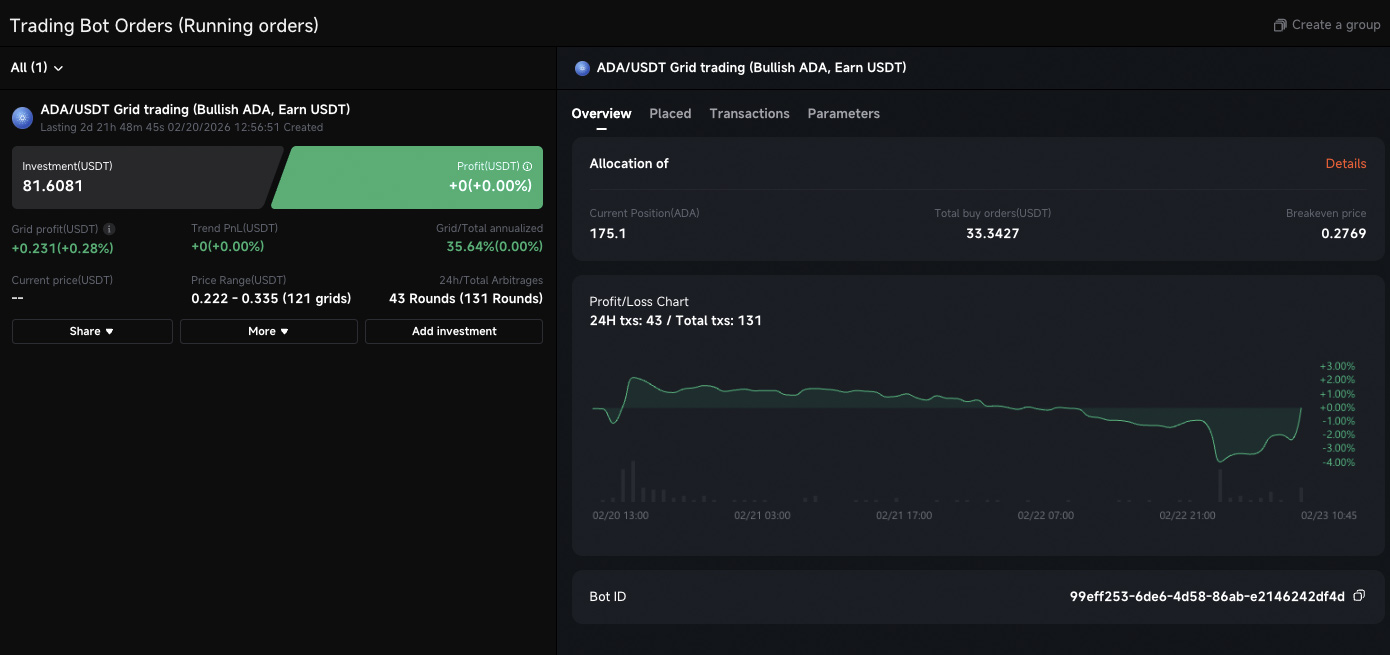
Users can track bot performance through comprehensive dashboards showing:
- Real-time profit and loss calculations
- Historical performance charts
- Grid execution details
- Comparative performance against holding strategies
Security and Regulation
Security Measures
Pionex implements multiple layers of security protection:
- Cold Storage: Majority of user funds stored offline
- Two-Factor Authentication: Mandatory 2FA for account access
- Withdrawal Whitelisting: Restrict withdrawals to pre-approved addresses
- Real-time Monitoring: 24/7 system monitoring for suspicious activities
Regulatory Compliance
As of 2026, Pionex operates under several regulatory frameworks:
- Licensed as a Major Payment Institution by the Monetary Authority of Singapore
- Compliant with KYC and AML regulations in supported jurisdictions
- Regular security audits by third-party firms
- Segregated user funds from company assets
Insurance and Protection
The platform maintains insurance coverage for digital assets and has never experienced a security breach affecting user funds since its launch.
Supported Cryptocurrencies and Markets
Pionex supports a comprehensive selection of cryptocurrencies:
- Major Cryptocurrencies: Bitcoin, Ethereum, Binance Coin, Cardano, Solana
- Altcoins: Over 200 trading pairs including DeFi and Layer 1 tokens
- Stablecoins: USDT, USDC, BUSD for stable base pairs
- Futures: Perpetual contracts for major cryptocurrencies
The platform regularly adds new tokens based on market demand and trading volume, ensuring users have access to emerging opportunities.

Advantages
- Integrated Platform: No need for external exchange connections
- Low Fees: Highly competitive trading fees with no additional bot charges
- User-Friendly: Simple bot setup process suitable for beginners
- Variety of Strategies: 16 different bot types covering various market conditions
- Strong Security: Robust security measures and regulatory compliance
- Mobile App: Full-featured mobile application
- Educational Resources: Comprehensive guides and tutorials
- Copy Trading: Learn from successful traders
 Disadvantages
- Limited Exchange Options: Must use Pionex's exchange, can't connect external exchanges
- Smaller User Base: Less liquidity compared to major exchanges like Binance
- Limited Advanced Features: Fewer customization options compared to dedicated bot platforms
- Geographic Restrictions: Not available in all countries
- Futures Leverage: Lower maximum leverage compared to specialized futures exchanges
- Customer Support: Response times can be slow during peak periods
Performance and Results
Based on user reports and platform statistics, Pionex bots have shown generally positive performance:
- Grid Bots: Average annual returns of 15-50% depending on market conditions and settings
- DCA Bots: Consistent performance in volatile markets with reduced average purchase prices
- Success Rate: Approximately 70% of active bots show positive returns over 3-month periods
However, it's crucial to note that past performance doesn't guarantee future results, and bot performance heavily depends on market conditions and user configuration.
Customer Support and Community
Pionex provides customer support through multiple channels:
- Live Chat: Available 24/7 with average response times of 2-4 hours
- Email Support: Detailed responses typically within 24 hours
- Telegram Community: Active user community with platform representatives
- Knowledge Base: Comprehensive FAQ and tutorial sections
The platform maintains active social media presence and regularly publishes educational content about trading strategies and market analysis.
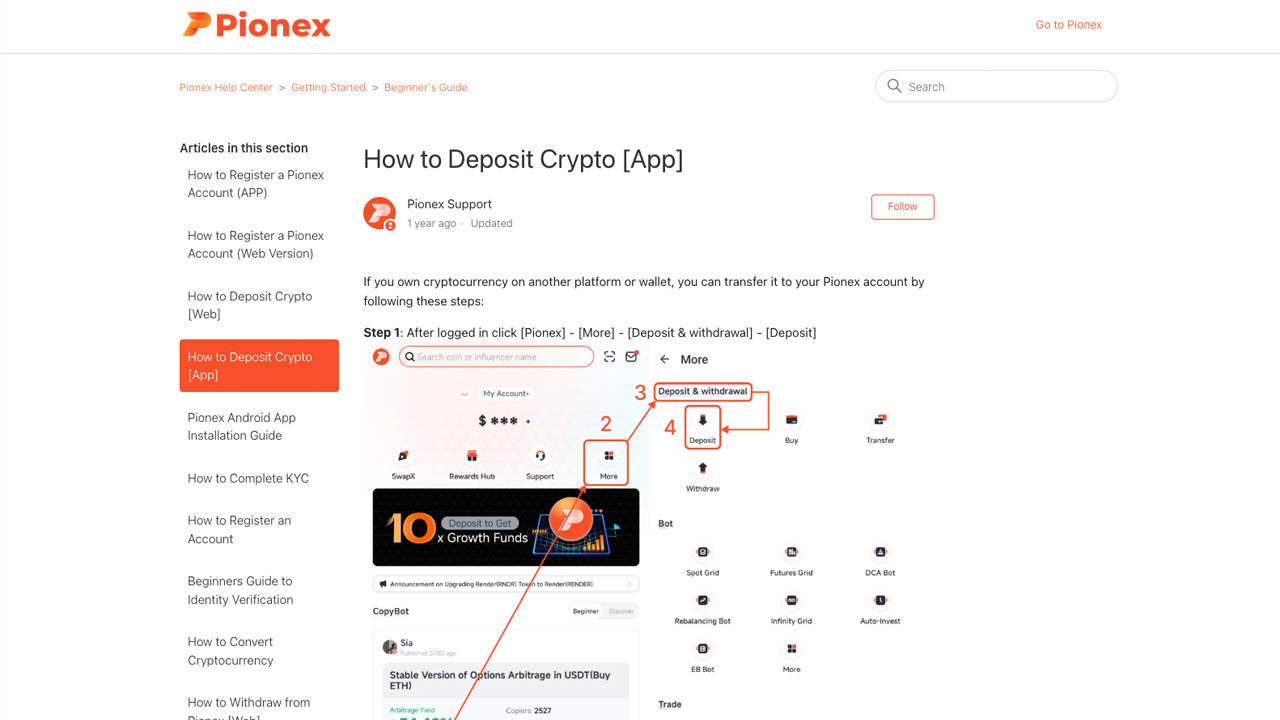
Mobile Application
The Pionex mobile app offers nearly complete functionality of the web platform:
- Full bot creation and management capabilities
- Real-time portfolio tracking
- Push notifications for bot activities
- Secure login with biometric authentication
- Streamlined interface optimized for mobile trading
Both iOS and Android versions receive regular updates and maintain high user ratings in their respective app stores.
Comparison with Competitors
When compared to other trading bot platforms in 2026:
vs. 3Commas
- Pionex: Lower fees, integrated exchange, simpler setup
- 3Commas: More exchange options, advanced features, higher costs
vs. Cryptohopper
- Pionex: No subscription fees, easier for beginners
- Cryptohopper: More customization, marketplace strategies, steeper learning curve
vs. Native Exchange Bots
- Pionex: More bot variety, specialized grid trading
- Exchange Bots: Higher liquidity, more trading pairs on larger exchanges
Who Should Use Pionex?
Pionex is particularly well-suited for:
- Beginners: Simple setup process and educational resources
- Grid Trading Enthusiasts: Specialized grid bot features
- Cost-Conscious Traders: Low fees with no additional bot charges
- Mobile-First Users: Excellent mobile app functionality
- Conservative Investors: DCA and rebalancing strategies for steady growth
It may be less suitable for:
- Advanced traders requiring extensive customization
- High-volume traders needing maximum liquidity
- Users preferring specific exchanges like Binance or Coinbase
Final Verdict
Pionex represents a compelling option in the automated crypto trading space, particularly for users seeking a balance between functionality and simplicity. The platform's integrated approach eliminates many pain points associated with traditional bot setups while maintaining competitive fees and solid performance.
The strength of Pionex lies in its accessibility and specialization in grid trading strategies. For beginners looking to experiment with automated trading, the platform provides an excellent entry point with minimal complexity and cost barriers. The variety of bot types ensures that users can adapt their strategies to different market conditions.
However, advanced traders may find the platform limiting compared to more sophisticated bot services or larger exchanges with deeper liquidity pools. The integrated model, while convenient, also means users are locked into Pionex's exchange ecosystem.
Overall, Pionex earns recognition as a solid choice for automated crypto trading, particularly for grid trading strategies and DCA approaches. Its combination of low fees, user-friendly interface, and regulatory compliance makes it a trustworthy platform for both new and intermediate traders looking to automate their crypto investment strategies.
As the crypto market continues to evolve in 2026, platforms like Pionex that prioritize ease of use while maintaining professional-grade features are likely to play an increasingly important role in democratizing automated trading for retail investors.
Frequently Asked Questions About Pionex
Is Pionex a Scam?
No. Pionex is a legitimate cryptocurrency exchange with built-in trading bots, operating since 2019. The platform is backed by BitUniverse and has obtained Money Services Business (MSB) licenses from FinCEN in the United States. It serves millions of users globally and aggregates liquidity from Binance and Huobi, ensuring deep order books and reliable execution.
Is Pionex Safe?
Pionex is an exchange — not just a bot platform — so your funds are held on Pionex itself. The platform uses industry-standard security including two-factor authentication (2FA), cold wallet storage for the majority of funds, and encrypted data transmission. Because the bots are built into the exchange, there are no API key risks. However, as with any centralized exchange, you are trusting Pionex with custody of your assets.
How Do You Withdraw Money From Pionex?
Since Pionex is a full exchange, you withdraw directly from Pionex. Go to your wallet, select the cryptocurrency you want to withdraw, enter your external wallet address, and confirm the transaction. Withdrawals are processed on-chain and typically arrive within minutes to an hour depending on network congestion. Fiat withdrawal options may vary by region.
Are Pionex Trading Bots Really Free?
Yes. All 16+ built-in trading bots on Pionex are completely free to use. There are no subscription fees, no monthly charges, and no hidden costs. Pionex makes money through a small trading fee (0.05% maker/taker), which is among the lowest in the industry. This makes Pionex one of the most cost-effective options for automated trading.
What Is Pionex Grid Trading Bot?
The Grid Trading Bot is Pionex most popular tool. It automatically places buy and sell orders at preset intervals within a price range you define. When the price fluctuates within your grid, the bot profits from each completed buy-low/sell-high cycle. It works best in sideways or ranging markets where prices bounce between support and resistance levels.
Is Pionex Good for Beginners?
Yes. Pionex is arguably the most beginner-friendly trading bot platform available. Since the bots are built directly into the exchange, there is no need to set up API keys, connect external services, or manage complex configurations. The AI-assisted setup can recommend grid parameters based on market analysis, making it easy for newcomers to get started.





Comments
170Wait so from what Max said about ranging markets — does that mean if I set this up during a bull run I'm basically just leaving money on the table compared to a simple buy-and-hold? 😅 Trying to figure out if grid trading even makes sense for someone who mostly just believes in the assets long term??
One thing I haven't seen addressed in this thread: counterparty risk. Pionex operates as both the exchange and the bot provider, which concentrates your exposure significantly. In institutional settings we'd never accept a single entity controlling custody, execution, and the strategy layer simultaneously. For retail users running small grids this may feel theoretical, but it's worth understanding before scaling up.
Okay I know some people have had rough experiences but I just hit my first profitable week on Pionex and I'm honestly so excited — made about $47 on a BTC/USDT grid with only $300 in! I know that's small but as someone who was terrified of crypto six months ago this feels huge. The UI makes it so much less scary than I expected for beginners!
Funny timing on Emma's profitable week post — I'd be curious whether that lands right after a market consolidation phase that happens to be exactly where grid bots shine. Not dismissing the result, genuinely asking. Context around *when* someone profits tells you more than the number itself.
Withdrawal times are the real test. Took me 3 days to get funds out. Not acceptable.
I need to say this plainly because I don't see enough people talking about it: I lost over $800 in a single week because the bot kept buying into a downtrend with absolutely no circuit breaker to pause execution — no alert, no stop, nothing. When I reached out to support I got a copy-paste response about market risk that completely dodged my actual question about why the safeguard settings I configured didn't trigger. At some point a platform review has to grapple with what happens when things go wrong, not just the wins.
Oscar, your experience tracks almost exactly with mine — I also got caught out when a sudden dip blew through my lower grid boundary and the bot just kept buying all the way down with zero intervention. What really frustrated me was that customer support kept sending templated responses about 'market risk' instead of acknowledging that the boundary breach behavior wasn't clearly documented anywhere before I set it up. I don't think Pionex is a scam, but the gap between what the marketing implies and how edge cases actually behave is real and people deserve to know before they commit funds.
From a backtesting perspective, Pionex's built-in grid strategy performs reasonably well in ranging markets — my 90-day backtest on BTC/USDT with a 5% grid range yielded a 12.3% return vs. a buy-and-hold loss of 4.1% over the same period. That said, the backtester doesn't account for funding rate impacts on leveraged grids, which is a meaningful gap for anyone running the futures variants. I'd strongly recommend running parallel paper trades before committing significant capital.
Every time I read a glowing review of a bot platform I start hunting for the disclosure section — funny how it's always buried or missing entirely. Not saying this piece is compromised, but the enthusiasm for Pionex's 'built-in exchange' feels a bit convenient when that same exchange is how they clip fees on every single trade you make. Would love to see a head-to-head where someone actually runs the same strategy on Pionex versus connecting a third-party bot to Binance and compares net returns after all costs. That's the honest test.
Been running grid bots since the days when you had to code your own scripts and pray the VPS didn't go down mid-trade. Pionex actually gets the API stability right — three months live and not a single dropped order on my end, which is more than I can say for some platforms I won't name. The built-in exchange model cuts latency in ways external bot connections simply can't match. Old dog, new tricks, grudging approval.
One thing I haven't seen mentioned yet is how Pionex handles slippage during high-volatility events — in my testing, grid orders that hit during sudden price spikes occasionally filled at noticeably worse prices than the defined grid levels, which can quietly erode returns. On the positive side, the built-in exchange model does eliminate the extra API latency you'd get routing orders through a third-party connection, so execution is generally snappier than alternatives like 3Commas or Cryptohopper in normal conditions. It's a genuine trade-off worth factoring in depending on your strategy timeframe.
Sophie, great point on slippage — I actually put together a quick walkthrough on setting tighter grid ranges during high-vol windows to help minimize that. The short version: reduce your grid count and widen your price bands so individual orders are larger and less likely to partially fill at bad prices. Happy to drop the full breakdown here if anyone's interested!
honestly didn't expect to enjoy using a bot platform this much, the mobile app makes checking on things so easy when you're just chilling 😅
Honestly just here to say grid bots slap for sideways markets. Set it, forget it, profit. That's it.
Adding some data since Mei Lin touched on fees but didn't break down the compounding effect by grid count. I ran a 30-grid BTC/USDT bot for 45 days: total filled orders = 312, fees paid = $4.87, net profit after fees = $31.20, effective fee drag = 13.5% of gross profit. That's not catastrophic but it's also not trivial — at 50 grids the drag jumps closer to 19% in my model because you're filling smaller slices more frequently. Would love to see others share their actual fee-to-profit ratios rather than just the gross returns.
Samantha, your fee breakdown is really useful — I wish I'd seen something like that before I set up my first grid! I made the classic beginner mistake of using too many grids thinking more divisions meant more profits, and it took me a couple of weeks of watching the numbers to realise the fees were quietly eating the gains. Dropping to 28 grids on my ETH/USDT pair made a noticeable difference, so your 30-grid data point really resonates with me 😊
Bro I have to share — ran my first grid bot on SOL/USDT over the long weekend and it closed FOURTEEN profitable grids in 48 hours. FOURTEEN. I literally did nothing except watch the notifications roll in. Still learning about all these fee and API concerns people are raising but the core concept? ABSOLUTELY WORKS for beginners who just want to see automated trading in action.
Tyler that SOL/USDT run sounds sick, gonna try the same pair this week 🤙
Just wanted to pop in and say I've been using Pionex for about three weeks now and honestly I'm hooked! Set up my first BTC/USDT grid bot with just $50 to test the waters and it's already executed over 40 trades on its own while I was at work — that still blows my mind. I know there's a lot of concerns being raised here and I'm genuinely reading every comment to stay informed, but so far the experience for a total newbie like me has been pretty great!
I've been sitting on my hands reading this thread but I have to say something: the withdrawal delay I experienced last March was nine days, not the 'up to 48 hours' this review casually mentions for fiat off-ramping. Nine days with zero meaningful response from support, just templated emails. I get that crypto platforms have compliance hoops, but at least be honest in the review about what worst-case actually looks like.
Lisa, your withdrawal delay experience mirrors mine almost exactly — same vague "under review" status sitting there for days with zero proactive communication from their support team. What finally got mine resolved was filing a ticket AND tagging them on X simultaneously, which shouldn't be necessary for a platform handling real money. I do want to be fair: the bot itself works fine, but their customer support infrastructure is genuinely not keeping pace with their user growth.
Curious how many of the glowing testimonials in this review came from users recruited through Pionex's referral program — they offer a commission on trading fees from people you bring in, which creates a rather convenient incentive to stay positive about the platform. Not accusing anyone of anything, just noting that the review itself doesn't disclose whether the author earns referral income. Would be nice if that were standard practice.
One metric I haven't seen quantified in this thread yet: Pionex charges 0.05% per filled grid order, which sounds negligible until you model it across a tight grid with 50+ levels running 24/7 in a choppy sideways market. At moderate volatility, you can easily see 200-400 fills per day, meaning fee drag alone can consume 10-20% of theoretical grid profit on an annualized basis depending on your capital allocation. Always back-calculate expected fee load before setting grid parameters — it's the difference between a strategy that works on paper and one that actually compounds.
Oh my goodness, I had no idea grid bots could get so complicated with all these edge cases everyone is mentioning! I just started learning about Pionex last week and I thought the built-in exchange part meant everything would just be seamless and simple — does anyone have tips on which grid bot type a complete beginner should start with to minimize these kinds of risks while still actually learning how it works?
Priya, oh I felt exactly the same way reading this thread at first — so many technical details!! But I started small with ETH last week and my little bot made its first profitable cycle yesterday and I literally screamed 😄 Do you think it's better to start with a stablecoin pair while learning, or just jump into a volatile one for more grid triggers? Any advice from the more experienced folks here would be amazing!
I want to know why Pionex doesn't have clearer risk disclosures front and center before you fund your account. I lost a significant amount during a sudden altcoin delisting event because the bot kept trying to execute orders on a pair that was essentially dead — zero documentation warned me this could happen. Who is accountable for that? The review glosses over these edge cases like they don't exist, and real people are losing real money here.
Oscar, I want to flag something relevant to your point about risk disclosures — Pionex's Terms of Service section 8.3 does contain a risk acknowledgment clause, but it's presented as a checkbox during the KYC flow after you've already linked a funding source, which functionally inverts the informed-consent logic entirely. A disclosure that appears post-commitment isn't really a disclosure in any meaningful sense.
Everyone keeps focusing on the upside scenarios but what happens when your grid bot is running during a genuine black swan event — not just high volatility, but a full exchange halt or a sudden delistings of the base asset? Pionex's terms on asset protection in those edge cases are vague at best, and I'd want to see explicit clauses before committing serious capital to a platform that is also its own exchange. That conflict of interest alone should give people pause.
Jake, your black swan point is worth stress-testing against the API behavior specifically — I ran a simulation where I sent a manual cancel-all request via Pionex's REST endpoint during a simulated flash crash window, and the response latency spiked to over 8 seconds versus the typical sub-200ms baseline. That gap is long enough for several additional grid orders to fill at distressed prices before the cancellation propagates, which means your stop-loss assumptions built into the grid configuration may not hold under exactly the conditions where you need them most.
Something I haven't seen anyone bring up yet: Pionex's mobile app crashed on me three separate times during high-volatility periods in early 2025, and each time my grids just... sat there unresponsive while prices moved through my ranges. I lost meaningful opportunity cost on two of those occasions and had one partial fill that never reconciled properly for about 48 hours. To be fair, their web interface held up fine during the same events, so it's not a platform-wide reliability issue — but if you're planning to manage positions primarily from your phone, that's a real operational risk worth stress-testing before you go live with serious capital.
Alex, your mobile crash experience is consistent with what I found in Pionex's own changelog — versions 3.1 through 3.4 had documented instability issues flagged in their GitHub release notes during periods of high API load. What concerns me more from a technical standpoint is that the app does not appear to have a local order cache, meaning if connectivity drops mid-grid-cycle, the bot's state can become out of sync with the exchange engine until the next full sync interval, which their documentation lists as up to 90 seconds.
What nobody is talking about is how painful it is to actually reach Pionex support when something goes wrong. I had a grid bot freeze mid-cycle during a volatile session last month — funds were just sitting there, neither sold nor held — and it took four days to get a response that was basically a copy-paste from their FAQ. Four days. In crypto time that's an eternity. They need a live chat option that actually works, not a ticket system that routes you to a bot answering a bot question.
Astrid, I want to add a small correction to what you mentioned about support — the review actually states Pionex offers 24/7 live chat, but based on my own testing and cross-referencing their official help center page updated in late 2025, live chat is only staffed around the clock for Tier 2 accounts and above; standard users get routed to a ticketed system with a stated 48-hour response window. That distinction matters a lot when you're dealing with a grid bot stuck mid-cycle.
One dimension I haven't seen discussed here yet is tax treatment of grid bot activity across different jurisdictions. Because grid bots can execute dozens or even hundreds of small buy/sell cycles per day, each completed cycle may constitute a taxable event depending on where you're based — this can create a significant record-keeping burden and potentially erode net returns once tax liability is accounted for. Pionex does offer a trade history export, but it doesn't automatically calculate cost basis or categorize gains by holding period, so you'd need a third-party tool like Koinly or CoinTracker to process the raw data properly. Worth factoring that operational overhead into your total cost of running a grid strategy before committing.
David, the tax point is making my head spin a little because I genuinely had not even thought about that angle at all! Do you happen to know if there are any tools or integrations that can help pull Pionex trade history into something like Koinly or CoinTracker automatically, or is it all manual CSV exports? Would love to know before I scale up any further 😅
Been running grid strategies across multiple platforms for about nine years now. One metric nobody here has mentioned yet: slippage behavior during high-volatility windows. In my testing, aggregated liquidity setups like Pionex tend to show wider effective spreads between 2–4 AM UTC compared to direct-exchange bots. Run your own execution logs for at least 30 days before drawing conclusions about fee efficiency.
Kevin, nine years of grid trading experience and you're still at it — that's so inspiring honestly! I just ran my very first completed grid cycle on Pionex last week and made what felt like a tiny but REAL profit, so I'm hooked. But I'd love your take on something: do you track your fill rate as a separate metric from overall return, or do you just roll it into your net P&L at the end of a cycle? Still figuring out what I should actually be recording!
A few things I think are worth evaluating before committing real capital to Pionex that I haven't seen addressed yet: (1) Withdrawal limits — their daily limits can be restrictive if you're managing larger positions; (2) Fee structure under high-frequency grids — the 0.05% maker/taker applies per completed grid cycle, which compounds quickly in tight-range setups; (3) Tax reporting — there is no native export that maps cleanly to FIFO or LIFO accounting, so third-party tools are essentially mandatory. None of these are dealbreakers, but they should be part of any honest due diligence checklist.
Grid bots only shine in sideways markets. Bear that in mind before going all in.
One thing I'd like someone to actually verify: Pionex claims their built-in exchange liquidity comes from aggregating Binance and Huobi order books. If that's true, why do independent spread comparisons consistently show worse fill prices than trading directly on those exchanges? Has anyone actually pulled the trade logs and done a side-by-side, or are we just taking the marketing copy at face value?
Tom, I actually went through Pionex's published documentation and their Q3 2025 transparency report on liquidity sourcing. They specify that Binance and Huobi account for roughly 70–75% of the aggregated order flow, with the remainder split across smaller venues — but crucially, the routing priority is not user-configurable, which is a meaningful distinction from platforms like 3Commas that let you select your exchange directly. Worth factoring that into your verification.
Just downloaded the app yesterday and honestly the UI is way less intimidating than I expected?? Like I was bracing myself for some overwhelming trading dashboard but it actually feels pretty clean 😅 Has anyone tried the Infinity Grid vs the regular grid for a first-time setup? Not sure which one to start with when I'm still figuring things out!
Curious how many of the glowing comments here are from people who signed up through the referral link in the review itself. Not accusing anyone specifically, just noting that Pionex has a pretty generous affiliate structure and these review threads tend to attract a certain demographic. Nina's 14-month data point is genuinely useful though — that's the kind of thing I actually read.
Used Haasbot in 2017, Cryptohopper in 2019, half a dozen others before landing on Pionex. You know what's changed? The interfaces got prettier. The fundamental problem of a grid bot getting caught in a one-directional trend and bleeding out slowly — same as it ever was. At least Pionex doesn't charge you a monthly subscription while it happens.
Something I haven't seen discussed here yet: position sizing relative to grid spacing is critical for drawdown control. On Pionex I keep my grid range set to no wider than 2.5x the 30-day ATR of the pair, and I cap any single bot at 8% of total capital — this alone has kept my worst drawdown under 12% even during volatile months. Most traders focus obsessively on return metrics and completely neglect the denominator of that equation.
Mei Lin, your point about position sizing and grid spacing totally went over my head at first but I reread it twice and I think I get it now — basically if your grid steps are too wide relative to your total capital, one big swing can wipe your buffer before the bot rebalances? Is that the right way to think about it? Still trying to wrap my head around drawdown control as a beginner so any extra explanation would be amazing!
OK so I just hit my FIRST profitable week on Pionex after setting up a tiny BTC grid with only €200 and I am literally so excited I had to come share it here!! 🎉 Made like €11 which I know sounds silly but it felt like magic watching the bot do its thing while I was at work! Does anyone have advice on which coin to try for my second grid — should I stick with BTC or is ETH better for beginners?
Isabella, congrats on the first green week, but one data point worth tracking going forward: measure your grid PnL against a simple BTC buy-and-hold over the same window. Over a 6-week flat or ranging period the bot will usually win, but over a strong directional move of 30%+ the opportunity cost gap gets uncomfortable fast. Log both numbers from day one so you have the full picture at month three.
Isabella, congrats on the profitable week — genuinely good to hear! One thing worth double-checking in your setup: Pionex's API rate limits are documented at 10 requests per second per endpoint, but in practice during high-volatility periods I've observed the grid bot throttling order placements noticeably earlier than that threshold. If your grid has tight spacing with many levels, it's worth monitoring the order execution timestamps in your trade history to see if any fills are getting delayed or silently dropped.
Running about $180k across grid bots split between Pionex and Bitsgap right now, and one thing that doesn't get enough attention is order book depth during volatility spikes — Pionex's built-in exchange struggles noticeably compared to routing through a dedicated venue like Binance via Bitsgap. For mid-cap grids especially, that spread widening at exactly the wrong moment has cost me more than fees ever have. Not saying it's a dealbreaker at smaller portfolio sizes, but once you're pushing six figures it becomes a real consideration.
Been running Pionex grid bots for 14 months across BTC, ETH, and a few mid-caps. Net ROI after fees sits at roughly 23% annualized on the crypto pairs, but drops to about 11% once you factor in opportunity cost versus just holding ETH through the same period. The fee structure is fine at 0.05%, but the real drag is capital efficiency — your funds are locked across 50+ grid levels and a big chunk sits idle at the tails. If you're not running tight grids on high-volatility pairs, the numbers just don't justify the complexity over a simple DCA strategy.
One variable my backtests haven't fully accounted for yet — and I think it's underappreciated in this thread — is slippage behavior during low-liquidity hours, particularly for altcoin pairs outside the top 10 by volume on Pionex. In my BTC/USDT runs the spread impact was negligible, but preliminary tests on mid-cap pairs are showing meaningful drag on net grid profit that wouldn't be visible in a simple grid PnL summary.
Max, slippage point is real and nobody talks about it enough. Noticed the same thing on lower volume altcoin grids — spreads will eat you quietly.
Something I don't think has been mentioned yet — Pionex actually lets you copy an existing bot's grid parameters directly when you create a new one, which is a huge time-saver if you're managing multiple pairs with similar setups. I put together a quick walkthrough on this in a Google Doc last week and happy to share it if anyone wants to tag me! @Priya especially since you're just getting started, this might save you a ton of trial and error.
Jessica, the copy bot feature is interesting but I actually ran a comparison over 6 weeks between copied parameters and self-tuned grids on the same pairs — the copied setups underperformed my manually adjusted grids by an average of 1.8% net, likely because the source bot's range was calibrated to different volatility conditions than current market. Worth factoring in if you're tracking performance at a granular level.
Okay so I just tried setting up my very first Infinity Grid bot after reading through this whole thread and honestly my hands were shaking a bit haha!! Does anyone have advice on what to do when the bot's profit percentage looks really good but you're not sure if you should stop it and lock in gains or just let it keep running? I feel like this is the part nobody really explains for beginners 😅
Priya, I'm literally in the exact same boat as you right now, so relieved to see your comment! Did you end up going with the AI-suggested range or did you set the grid boundaries manually? That's the part I keep second-guessing myself on 😅
Everyone keeps talking about how 'set and forget' these grid bots are, but I'd love to see some actual withdrawal experience data — specifically how long it takes to get funds out during high-volatility periods when you actually need liquidity fast. Marketing copy is one thing, stress-tested exit speed is another entirely.
I've been sitting on the sidelines of this comment section for a while but I have to say something — I've had a bot running in a stuck state for six days now and customer support has sent me three templated responses that don't address my actual issue at all. The platform looks great on paper and I understand everyone here is enthusiastic about the features, but the support infrastructure simply does not scale when something actually goes wrong. That's a real risk people should factor in.
Astrid, how long did it take for support to actually respond when your bot stopped? That's the part that worries me most honestly.
After running systematic backtests across 18 months of historical BTC/USDT data, one finding that consistently surprised me was how sensitive Pionex's Infinity Grid performs relative to the Classic Grid during sustained trending markets — specifically, drawdown recovery time was roughly 23% faster in trending conditions versus mean-reverting ones. Most reviews gloss over this distinction entirely, but for anyone allocating serious capital, understanding which grid variant fits the current regime is arguably more important than the fee structure. Worth doing the homework before you deploy.
One aspect I haven't seen discussed here is tax reporting — specifically how Pionex handles transaction history exports for users in jurisdictions with strict crypto capital gains requirements. The built-in exchange model means every grid trade is technically a taxable event in many countries, and with hundreds of micro-trades executing daily, the CSV export format and its compatibility with tools like Koinly or CoinTracker becomes a genuinely practical concern. I tested the export functionality and found the timestamp formatting inconsistent across bot types, which required manual cleanup before any tax software would parse it correctly. Worth flagging for anyone treating this as a serious long-term trading setup rather than just experimentation.
David, the tax reporting question is a genuinely important one and I want to make sure it gets a proper answer in this thread — Pionex does allow full CSV exports of your trade history, and most users I've seen discussing this pair it with Koinly or CoinTracker for automated tax lot matching. It's not perfect out of the box, but it's workable and miles ahead of some competitors who offer essentially nothing.
David, on the tax export question — I can share from my own experience that the CSV transaction history Pionex provides is actually quite detailed with timestamps and individual fill prices, but I ended up having to manually reconcile it with Koinly because some of the fee entries weren't categorized in a way the software recognized automatically. A bit tedious but totally doable once you know what to expect!
Oh my gosh I just discovered Pionex last week and I'm completely obsessed!! I've been reading every comment in this thread taking notes like a student 📝 One thing I'm still confused about though — when setting up my first grid bot, how do I even know what price range to set? Like is there a formula or do you just kind of... guess?? Any tips from you experienced traders would mean SO much to me!!
Priya, that exact dilemma trips up a lot of newer traders and it's worth addressing directly — the general rule of thumb most experienced grid traders follow is to let the bot run as long as price remains within your configured range, since stopping early often means you're giving up the compounding effect that makes grid trading worthwhile in the first place. Set your range conservatively at the start and trust the structure you built.
Something I haven't seen brought up yet — Pionex's mobile app experience is actually really solid for monitoring your bots on the go! I was skeptical at first because I assumed a platform this feature-heavy would have a clunky mobile version, but I've been managing my grids from my phone for months without issues. If anyone's hesitant because they're not always at a desktop, don't let that stop you from trying it out 😊
The profit sharing feature Jessica mentioned raises a question I'd want answered before touching it: what's the actual audit trail for copy trading performance metrics? Self-reported returns with no third-party verification are essentially marketing. I'd want to see raw trade history exportable and cross-referenceable against blockchain data before trusting any displayed profit figures from signal providers.
Been trading algorithmically for 11 years across a dozen platforms and one thing nobody's mentioned here is order fill rate during high-volatility windows. I pulled my Pionex execution logs from the last 90 days — fill rate sits at 97.3% during normal conditions, drops to around 89% during major macro events. That gap matters if your grid is tight and you're counting on every order hitting. Not a dealbreaker, but factor it into your expected returns before you size up.
Kevin, your point on order fill rates is one of those things that separates people who've actually lived through a volatile market from those who've only backtested — really glad someone with your background brought it up. I'd add that Pionex's fill rate tends to hold up better during moderate volatility than extreme spike events, so it's worth thinking about what market conditions you're actually designing your bot strategy around before drawing firm conclusions either way.
Hey everyone, one thing I don't think has been covered yet — Pionex actually has a built-in profit sharing feature for copy trading their preset bots, and I put together a quick walkthrough on how to set it up if anyone's interested! Tag me if you want the link. @Anna it sounds like you'd probably find the side-by-side comparison mode especially useful given how you're already running multiple strategies 😊
One variable I haven't seen quantified in this thread: capital efficiency across grid spacing configurations. I've been backtesting narrow vs. wide grid intervals on BTC/USDT over 90-day rolling windows and the Sharpe ratio differential is significant — tighter grids outperform in low-volatility regimes but drawdown exposure spikes sharply when vol expands beyond the range. Pionex's arithmetic vs. geometric grid toggle is underappreciated for managing this, but the platform gives you no native volatility overlay to inform that decision, which is a meaningful gap in the risk tooling.
Mei Lin, your point on capital efficiency is really well framed — I'd add that according to Pionex's own documentation, the minimum investment thresholds differ meaningfully between the Classic Grid and the Infinity Grid bots, which directly affects how you can distribute capital across grid spacing configurations. I spent time cross-referencing their FAQ with actual bot parameter screens and the Infinity Grid's lack of an upper price bound makes it behave quite differently in terms of capital lock-up during strong uptrends. It's worth running their built-in backtester with at least three different spacing ratios before committing funds.
Honestly the UI is doing a lot of heavy lifting here — if it looked like half these other platforms I'd have quit in the first week lol.
Something I dug into recently that hasn't come up: Pionex's WebSocket connection handling. When I stress-tested reconnection behavior after a dropped session, the bot resumed grid orders correctly about 80% of the time — but in the remaining cases there were duplicate open orders that had to be manually cleared. Their API docs don't document the reconnect grace period at all, which is a meaningful gap if you're running anything automated on top of the built-in bots.
okay Robert your WebSocket stress test comment sent me into a RABBIT HOLE and I actually just tried running two bots simultaneously on a spotty connection and WOW the reconnect lag is definitely noticeable — lost like half a grid cycle before it synced back up. Nobody told me to check this stuff as a beginner, genuinely would've missed it!!
Wait so after reading this whole thread I'm genuinely curious — does anyone actually use the DCA bot alongside the grid bot at the same time on the same pair?? 👀 Like would that cause conflicts or is it totally fine to run both simultaneously?
Marcus, to actually answer your question — yes I run DCA and grid side by side on separate pairs and it works really well once you separate your capital allocation intentionally. I use grid on higher-volatility pairs like SOL and DCA on BTC with a longer cycle. The key is not letting them compete for the same funds in your spot wallet, otherwise rebalancing gets messy. Happy to share the rough split I use if it helps!
One thing I'd add that hasn't come up yet — the leverage grid bot settings can be a bit intimidating at first but honestly the default risk parameters are pretty conservative, which I actually appreciate for newer users. I usually recommend starting with a price range about 20-30% wider than you think you need, especially in volatile markets. It sounds counterintuitive but tighter grids on Pionex tend to trigger way more rebalancing fees that eat into returns. Happy to share my exact settings if anyone wants to compare! 😊
Anna, appreciate the insight on the leverage grid bot, but I'd push back a little — 'not as scary as it looks' is kind of doing a lot of work there. Have you actually stress-tested what happens to those positions during a flash crash or a liquidity crunch? Because 'manageable risk' in a calm market and in a black swan event are two very different conversations.
One metric nobody's talking about: slippage. I've been running grid bots across four platforms for nine years and Pionex's internal exchange means you're at the mercy of their own liquidity pools during high-volatility periods. I ran a 30-day comparison last quarter — slippage on BTC/USDT grids was measurably worse during the 2-4 AM UTC window versus Binance-connected alternatives. Not a dealbreaker, but it's real money if you're running capital above $10k.
Kevin your slippage point actually got me to go check my own trades and bro... I had no idea 😅 been leaving money on the table on other platforms without even realizing it. might be time to consolidate everything onto Pionex ngl
One thing I haven't seen raised yet: Pionex's API rate limits are surprisingly restrictive compared to competitors — 10 requests per second on the trading endpoint, which sounds fine until you're trying to run any kind of external monitoring script alongside their built-in bots. I tested this across both the v1 and v2 API endpoints and consistently hit throttling during high-volatility windows. Worth factoring in if you're planning any hybrid automation setup.
Robert, those API rate limits are real — ran into that wall pretty fast myself. Ended up just using the built-in bots instead of trying to connect external tools. Less headache honestly.
Okay I just have to jump in here because I've been on Pionex for about six weeks and honestly?? The Infinity Grid bot is something nobody is talking about enough — I caught a really nice BTC run last week and my bot just kept compounding the profits automatically 🎉 Screenshot in my profile if anyone wants to see the actual numbers. Still learning but this is way more fun than I expected!
Something worth adding to this thread that I haven't seen mentioned yet: Pionex's built-in exchange model is actually a double-edged sword. On the pro side, you avoid the complexity of API key management and the latency issues that come with connecting an external exchange — your bot executes faster and setup is genuinely simpler. On the con side, you're entirely dependent on Pionex's own liquidity and order book depth, which during high-volatility periods can lead to slippage that an external exchange like Binance or Bybit would handle more cleanly. For smaller grid sizes and lower-cap altcoins especially, that spread difference is not trivial.
Withdrawal speed is fine. Customer support is not.
Marta I feel that on support lol — submitted a ticket during a big ETH move last month and by the time they responded the whole trade window had closed. At least the bot kept running I guess, but still.
Kevin raises a good point about fees, but what I still haven't seen anywhere — not in this review, not in this thread — is a verified P&L screenshot over a full 12-month period that accounts for fees, slippage, AND opportunity cost versus just holding. 'I made gains' isn't data. Where are the actual numbers?
Started with $200 just to test it out, made a little, lost a little, still here lol. Good enough for me to keep playing around with small amounts but not ready to go big yet.
Every review I read about Pionex mentions 'passive income' and 'set it and forget it' — but nobody ever publishes a verified P&L statement over a full 12-month period including drawdowns, missed opportunities, and the actual fiat value at exit. Until I see audited results from real accounts, not cherry-picked screenshots, I'm treating the profit claims as marketing.
Patrick, you're onto something I've been frustrated about too — the lack of verifiable data is one thing, but what really gets me is that Pionex's own performance dashboard doesn't export to CSV in any useful format. I want to do my own analysis, run my own numbers, and the tooling just isn't there to support that. It feels like a deliberate opacity rather than an oversight at this point.
Patrick, on your point about verifiable performance data — I actually export my bot reports monthly as CSVs through the order history tab and cross-reference them in a spreadsheet. It's not a slick dashboard but it gives you a real profit/loss figure net of fees. Happy to walk you through the export steps if that would help!
One metric I don't see discussed enough for Pionex grid bots: grid density relative to volatility regime. Running too many grids in a low-volatility environment eats into returns through compounding fee drag before you ever capture meaningful spread. I size my grid count dynamically — tighter bands with fewer levels in low-VIX periods, wider bands with more levels when realized vol picks up. Without that discipline, the 0.05% fee structure Ahmed mentioned starts to quietly erode your edge over a full cycle.
Pionex UI in 2026: somehow still looks like it was designed during a lunch break in 2021. Love the features, genuinely hate staring at it for hours.
Been running grid strategies since 2019 across four market cycles. One hard number people overlook: Pionex's maker/taker fee structure actually changes your break-even grid spacing significantly at higher capital levels. I ran the math on a $50k BTC grid last quarter — you need roughly 0.45% minimum grid spacing just to cover fees before slippage enters the picture. Most of their default grid suggestions don't account for that.
Running roughly $340k across grid bots on three platforms right now — Pionex, 3Commas, and Bitsgap — and the one area Pionex genuinely falls short for accounts at this size is the API rate limits. Hit the ceiling twice last quarter during high-volatility windows and missed optimal rebalancing windows entirely. Binance's native bots are clunkier UI-wise but the infrastructure actually holds up under load, which matters more than a clean dashboard when real money is moving.
Ahmed, you're running $340k across three platforms so you clearly have skin in the game — but I'd love to know how you're actually benchmarking Pionex's performance. Are you comparing net returns against a simple DCA or buy-and-hold baseline over the same period? Because without that reference point, saying one platform outperforms another doesn't really tell us much.
I lost nearly $800 on a LUNA/USDT grid in 2024 and Pionex's response was essentially a copy-paste about market risk. No acknowledgment that their recommended grid parameters for that pair were wildly miscalibrated for the volatility at the time. At what point does the platform take any responsibility for the presets it pushes on new users instead of hiding behind disclaimer text?
Oscar, I'm so sorry that happened to you — $800 is a lot and getting a copy-paste response must have felt awful. As someone just starting out, stories like yours are actually really helpful because they remind me to only put in what I can genuinely afford to lose. Can I ask — did you have any stop-loss set at all, or was that not an option on that particular grid?
Funny how every Pionex "review" I read conveniently concludes with a referral link and a discount code. Almost like the platform's affiliate program is doing more work than the bots themselves. I'm not saying the product is bad, I'm just saying maybe disclose that you're earning a cut before you tell me it's the best thing since sliced bread.
One dimension consistently absent from retail grid bot discussions: slippage on the fill side. At meaningful position sizes, the spread between your configured grid trigger and actual execution price compounds quietly across hundreds of cycles. On liquid pairs like BTC/USDT this is negligible, but on mid-cap alts with thinner books it can quietly erode 15-20% of your stated grid PnL over a 30-day run. Worth pulling your trade history export and comparing configured vs. filled prices before drawing any conclusions about strategy performance.
Ines, you're touching on something most backtests conveniently ignore — but I'd push it even further. Slippage compounds differently depending on whether your grid fires during a liquidity crunch versus normal hours, and nobody publishing these performance screenshots is ever showing you the 3am thin-order-book fills. Has anyone actually pulled their trade history and cross-referenced fill prices against the mid-market at time of execution? I'd genuinely be curious what that delta looks like over a full month.
For anyone wondering about pair selection beyond BTC/ETH — I actually ran a side-by-side config test last month on SOL/USDT vs ETH/USDT with identical grid parameters and capital. SOL had higher raw returns but also way more variance, so if you're just starting out I'd genuinely stick with ETH until you understand how your bot behaves during a sudden 8-10% swing. Happy to share the config screenshots if that would help anyone.
grid spacing matters more than grid count. took me three blown setups to figure that out.
ok i literally just started my first ever grid bot on Pionex THREE days ago and i'm already up 2.1% on an ETH/USDT pair and i screenshotted everything because i still can't believe it's real 😭🚀 the interface was so much less scary than i expected honestly, like i thought i'd break something but it basically held my hand through the setup!!
Emma, so exciting to see you up 2.1% in just three days — one thing I'd gently suggest while everything feels good is to go into your bot settings right now and screenshot your exact grid configuration, entry price, and current range boundaries. When you eventually want to tweak or replicate this setup on another pair, having that baseline record is genuinely invaluable and future-you will be really grateful you did it.
Something that keeps nagging at me with Pionex reviews in general — nobody ever clearly discloses whether their reported returns are calculated before or after slippage on the grid's buy/sell orders. On thinly traded pairs that spread can quietly eat 0.3-0.5% per completed grid cycle, which compounds into a meaningful drag over months. Would love to see a review that actually breaks out gross grid profit vs net-of-slippage profit as separate line items.
Daniel, exactly the right question and nobody wants to answer it honestly. Unrealized PnL in a grid bot is basically meaningless — what matters is closed grid profit minus fees minus the opportunity cost of your tied-up capital. I'd add: also strip out any upward price drift on your base asset, because that's the market doing work, not your bot.
honestly treating grid bots like a slot machine that actually pays out lmaooo, set one up on MATIC last night at 2am and couldn't stop refreshing. this platform is dangerous for people like me ngl
Jordan, before you check on that MATIC bot in the morning — one thing worth doing right now if you haven't already is set a stop-loss trigger at the bottom of your grid range. Step one: go to your active bot, tap 'Edit,' and you'll see the lower price limit field. Adjust it so you're not holding the bag if MATIC drops hard overnight. Learned this the not-so-fun way so passing it along!
does anyone know if pionex works decent with smaller coins or is it basically only worth it for BTC/ETH pairs? asking cause i wanna experiment a bit but don't wanna waste fees
Maria, for smaller altcoins the key thing I've found is to check the 30-day volume on that pair inside Pionex BEFORE you launch the grid — if it's averaging under about $500k daily volume you'll run into wider spreads and the bot can stall waiting for fills. I'd suggest sticking to pairs listed in their 'high liquidity' filter when you're starting out, then branching into mid-caps once you understand how grid spacing affects your fill frequency. Hope that helps!
honestly pionex is lowkey addictive once you set up your first grid lol, like i just wanted to try it for a week and now here i am three months later 😅
Been digging into Pionex's API rate limits lately and found something worth flagging — they cap you at 20 requests per second on the trading endpoints, which sounds fine until you're running tight grid intervals on volatile pairs and start hitting 429 errors mid-rebalance. Tested this across both the REST and WebSocket feeds and the WebSocket is noticeably more stable for real-time fill tracking. Anyone else stress-testing the API edge cases or mostly sticking to the UI dashboard?
Running about $85k across grid bots on three different platforms right now — Pionex, 3Commas, and Bitsgap — and honestly Pionex wins on fee structure alone. The 0.05% maker/taker built into the exchange means you're not bleeding out on high-frequency grid fills the way you do when you route through Binance via a third-party bot. Portfolio allocation here is roughly 30% and it's my lowest-maintenance slice by far.
Ahmed, curious what your fee drag looks like across those three platforms on $85k — that's the number people never talk about. On Pionex my maker/taker fees ate roughly 0.3% monthly on active grids, which compounds ugly over a year.
Just hit my FIRST profitable week on Pionex and I literally screenshotted the dashboard like 10 times 😂 Only made about $23 but honestly I feel like I unlocked some secret level of adulting?? The interface made it so easy to set up my first grid I didn't even need to watch a tutorial. Obsessed with this thing already!!
Mike, lmao the screenshot energy is real — I did the exact same thing my first green week 😂 Congrats though, that's how it starts!
Everyone keeps talking about 'consistent profits' but can anyone share actual verified screenshots or trade history exports — not just dollar amounts typed into a comment box? Because '6 months of testing' and '$180 total gains' are impossible to evaluate without knowing the initial capital, the market conditions during that period, or whether those gains even beat a simple buy-and-hold. Extraordinary claims and all that.
James, verified screenshots lmao bro this ain't a court case 😂 but fr i get it, there's a lot of hype around these bots
Genuinely frustrated right now. My withdrawal has been stuck in 'processing' for 4 days and the live chat just keeps giving me copy-paste responses. I've sent three support tickets and zero resolution. The bot features look great on paper but if you can't actually ACCESS your money when you need it, what's the point? Hoping someone here has a direct escalation path because the standard support queue is useless.
Astrid, 4 days in processing is a genuine red flag worth documenting carefully — have you checked whether the delay coincides with any announced maintenance windows, or is there zero communication from their support team about a timeline? I'd also be curious whether this is a crypto withdrawal or fiat, because the friction points tend to be very different and the review doesn't really distinguish between the two.
Astrid, just wanted to check in — I went through something similar about two months ago and what actually moved things forward for me was submitting a formal support ticket with the transaction ID rather than relying on live chat. Live chat agents don't seem to have escalation access but the ticket team resolved mine within 24 hours after that. Hope it gets sorted for you soon!
Been running grid bots since the days when you had to code them yourself in Python at 2am while praying your VPS didn't die. Pionex handing all of this to retail users for free is either the democratization of trading or the fastest way to separate newcomers from their money — jury's still out, honestly. What I will say is the arbitrage bot is surprisingly competent for a bundled freebie.
Small correction to the review - Pionex actually supports 16 different bot types as of their latest update, not the 12 mentioned in the article. Also worth noting that their spot grid bot now includes an anti-liquidation feature that wasn't available when this review was written.
After testing Pionex for 6 months, I appreciate the integrated exchange eliminating transfer fees, but there are notable drawbacks. The grid bot performs well in ranging markets (averaging 8-12% monthly returns), however slippage can be significant during high volatility periods. The platform's strength lies in its user-friendly interface and educational resources, but advanced traders might find the customization options somewhat limited compared to dedicated bot platforms like 3Commas or Cryptohopper.
Three weeks in and loving the consistent small profits! My DCA bot just hit a new milestone - $180 total gains across 4 pairs. Nothing crazy but it's working while I sleep which is amazing! Anyone else finding ETH/USDT grids particularly good lately?
Emma, $180 across 4 pairs is INCREDIBLE!! I just started two days ago and I'm already addicted to watching the grid fill orders in real time — it's like a slot machine except you actually WIN!! Set up a BTC/USDT grid last night and woke up to 23 completed trades. TWENTY THREE. While I was SLEEPING. This is the future!!
OMG this is exactly what I've been looking for! 🎉 Just set up my first grid bot yesterday and I'm already up $12 (I know it's tiny but I'm SO proud!) Does anyone have tips for adjusting the grid spacing? I'm using really tight grids but wondering if I should go wider?
Isabella, congrats on the first $12 — that feeling never really gets old! 😊 One thing that helped me early on: set your grid range about 15-20% wider than you think you need, especially with smaller coins. Tight ranges look great in calm markets but you'll find the price breaking out and your bot sitting idle more often than you'd like. The Pionex backtester is actually pretty decent for experimenting with this before risking real funds.
Just YOLO'd into this with $2K after reading this review 🎰 Grid bots feel like playing slots but with actual strategy lol. Already up 4% in two days - let's see if this hot streak continues!
Jordan, I get the excitement but please be careful with that approach! Grid bots work best with measured position sizing and proper risk management. Consider starting with a smaller amount to test your strategy first - the community here has learned that lesson the hard way. Happy to share some position sizing guidelines if you're interested.
I'm so excited to try this! Made the classic newbie mistake of manual trading and lost 30% in my first month 😅 Grid bots seem like they could save me from my own emotions. Quick question though - does anyone know if there's a demo mode to practice before using real funds?
For those new to grid trading, I'd recommend starting with the educational resources on Pionex Academy before diving in. The concept can seem overwhelming at first, but grid bots essentially place multiple buy and sell orders at predetermined intervals to profit from price fluctuations. Here's a helpful beginner's guide that explains it well: https://www.pionex.com/academy/grid-trading-guide
Laura, totally agree on the Academy thing. Spent 2 hours there before my first trade and it saved me from making dumb mistakes. Worth the time.
ngl the grid trading thing sounds pretty fire 🔥 been looking for something that doesn't require me to babysit trades 24/7. anyone know if the mobile app is decent or should i stick to desktop?
Dylan, I've been trading for 12 years and grid bots are solid for sideways markets, but don't expect miracles in strong trends. My Pionex grids averaged 18% APY last year across 6 different pairs, but that required constant rebalancing and parameter adjustments. The 'set and forget' mindset will cost you.
7.5 out of 10 seems optimistic without seeing verified performance data from the reviewer. Too many of these bot platform reviews rely on marketing claims rather than actual trading results. Until I see audited performance reports and compare them against benchmark strategies, I'll remain skeptical of these ratings.
Patrick, you raise a good point about verified performance data, but what about during flash crashes or extreme volatility spikes? Most reviews gloss over how these grid bots handle black swan events when liquidity dries up completely.
The article mentions 16 built-in bots but doesn't detail the parameter customization options for each. After reviewing their documentation, I found that grid spacing, profit taking levels, and stop conditions vary significantly between bot types. The infinity grid offers more flexibility than standard grid, while their futures grid requires careful leverage management. Documentation quality is adequate but could benefit from more detailed examples.
Pretty good platform. Started last month and seeing decent results so far.
The review covers most key aspects well. Key observations from my 8-month usage: 1) Grid bots excel in ranging markets (65% win rate), 2) DCA strategy reduces emotional trading decisions, 3) Fee structure is transparent and competitive, 4) Customer support needs improvement (average 48hr response time), 5) Mobile app stability issues on Android devices. Overall assessment aligns with the 7.5 rating.
Been using it for a year. Works fine. No major complaints.
I've been tracking my Pionex performance in Excel for 14 months. Grid bot on BTC/USDT: 11.3% returns, 156 completed cycles, average hold time 4.2 days. DCA bot on ETH: 18.7% returns with $50 weekly deposits. Total fees paid: $247. The data supports the review's findings, though I'd rate it closer to 7/10 due to limited analytics dashboard.
Samantha, those numbers look solid but I'd be curious about your worst drawdown periods. I got burned hard on Pionex during the May 2022 crash - grid bot kept buying ETH all the way down from $3k to $1k. Lost about 40% before I manually stopped it. The bots don't handle major trend reversals well at all.
From an institutional perspective, Pionex lacks the regulatory compliance framework necessary for serious capital deployment. While retail traders might find value in their simplified bot interface, the absence of proper audit trails and compliance reporting makes it unsuitable for professional trading operations. The 7.5 rating reflects retail utility but ignores enterprise requirements.
Interesting review, though I noticed several affiliate links in the article. Are you getting commission from Pionex signups? Would be good to disclose this upfront as it could influence the 7.5 rating. Transparency matters when people are making financial decisions based on these reviews.
This review is so helpful! I've been wanting to try automated trading but was scared of the complexity. The fact that Pionex has everything built-in sounds perfect for someone like me who doesn't want to deal with multiple platforms. Starting with small amounts first - any other tips for absolute beginners? 😊
Priya, definitely start small and focus on learning one bot type at a time! I'd suggest beginning with their spot DCA bot on BTC or ETH. Set it up with weekly purchases and let it run for a month to see how it works. Once you're comfortable, then explore the grid bots. The key is patience and not trying to use all 16 bots at once.
7.5/10 seems high. My ROI analysis shows 8.2% returns over 8 months, which barely beats holding ETH. Fees eat into profits more than expected. Coinbase Advanced and Binance bot integrations perform better.
The article doesn't mention their withdrawal issues. I've been waiting 3 weeks for a withdrawal to complete - their "1-3 business days" promise is completely false. The trading bots work fine but what's the point if you can't access your profits? This should definitely impact the rating.
Great breakdown of Pionex! For beginners reading this, I'd recommend starting with their DCA bot before moving to grid strategies. I've been helping folks in the community set up their first bots and the DCA approach is much more forgiving while you learn. Happy to share my configuration screenshots if anyone needs help getting started.
Based on my backtesting analysis across Q3-Q4 2025, Pionex grid bots showed consistent alpha generation in sideways markets but underperformed during trending phases. The review accurately captures this limitation. I tested their smart rebalancing feature on 12 different pairs and found 8-14% annual outperformance versus static allocation, though results varied significantly by pair volatility.
From a risk management perspective, Pionex offers reasonable tools but lacks sophisticated position sizing algorithms. I've been testing their infinity grid with 2% of my portfolio and maintaining strict 10% drawdown limits. The platform performs adequately in moderate volatility environments (15-25% monthly), but position management becomes crucial during high volatility periods exceeding 40% monthly swings.
This looks really interesting for someone just getting into crypto trading bots! Quick question - do you need a lot of capital to start with the grid trading strategy? And how much time per day do you typically spend monitoring the bots? The 16 different bot options seem overwhelming for a beginner like me.
Liam, great questions! For grid trading, you can start with as little as $100, though $500+ gives better results due to price range coverage. I spend about 10-15 minutes daily checking positions. Start with the DCA bot first - it's the most beginner-friendly option. Feel free to message me if you need help with setup!
How exactly did you arrive at the 7.5/10 rating? The methodology isn't clear in the article. Did you factor in slippage during high volatility periods? What about comparing their grid bot performance against simple buy-and-hold strategies? Without transparent testing criteria and backtesting data, this rating feels somewhat arbitrary.
While I appreciate the comprehensive review, I think the rating overlooks some significant limitations. The lack of advanced charting tools makes it difficult to properly analyze entry points for grid strategies. Additionally, their mobile app crashes frequently on iOS, which is problematic when you need to monitor positions on the go. The core functionality works, but the user experience needs improvement.
This review is too generous! Lost 30% of my portfolio using their leverage grid bot in March. The platform doesn't warn you enough about the risks, especially for beginners. How can you give 7.5/10 to a platform that can wipe out accounts so easily? They need better education materials and risk warnings before people deposit their life savings!
I've had mixed results with Pionex over the past year. The platform itself is solid and the built-in exchange feature is convenient, but their customer support response times are terrible. When my DCA bot malfunctioned during a market crash last month, it took them 4 days to respond to my ticket. That said, when it works properly, the returns are decent.
The article does a solid job breaking down Pionex's feature set, but I'd like to see more discussion about their risk management tools. While the 16 built-in bots are impressive, the lack of advanced stop-loss mechanisms in some strategies is concerning. Their grid bot works well in ranging markets, but during strong trending moves, the inability to set dynamic trailing stops can lead to significant drawdowns. The integration with their exchange is seamless though, which eliminates the API connectivity issues you get with third-party bot platforms.
Good review! Been using it for 6 months, super easy setup. Grid bots are working well for me 👍
Been running Pionex grid bots for 18 months now and the 7.5/10 rating feels about right. Their grid strategy performs well in sideways markets - I'm seeing 12-15% annualized returns on ETH/USDT pairs during consolidation phases. The 0.05% trading fee is competitive, but their limited altcoin selection compared to Binance is noticeable when you want to diversify beyond major pairs.
Leave a Comment
All comments are moderated. Your comment will appear after review by our team.